Written rejection criteria, posted
Mounted at both grading stations since 2011. Reproduced in full on this site so you can hold us to them or copy them into your own receiving spec.
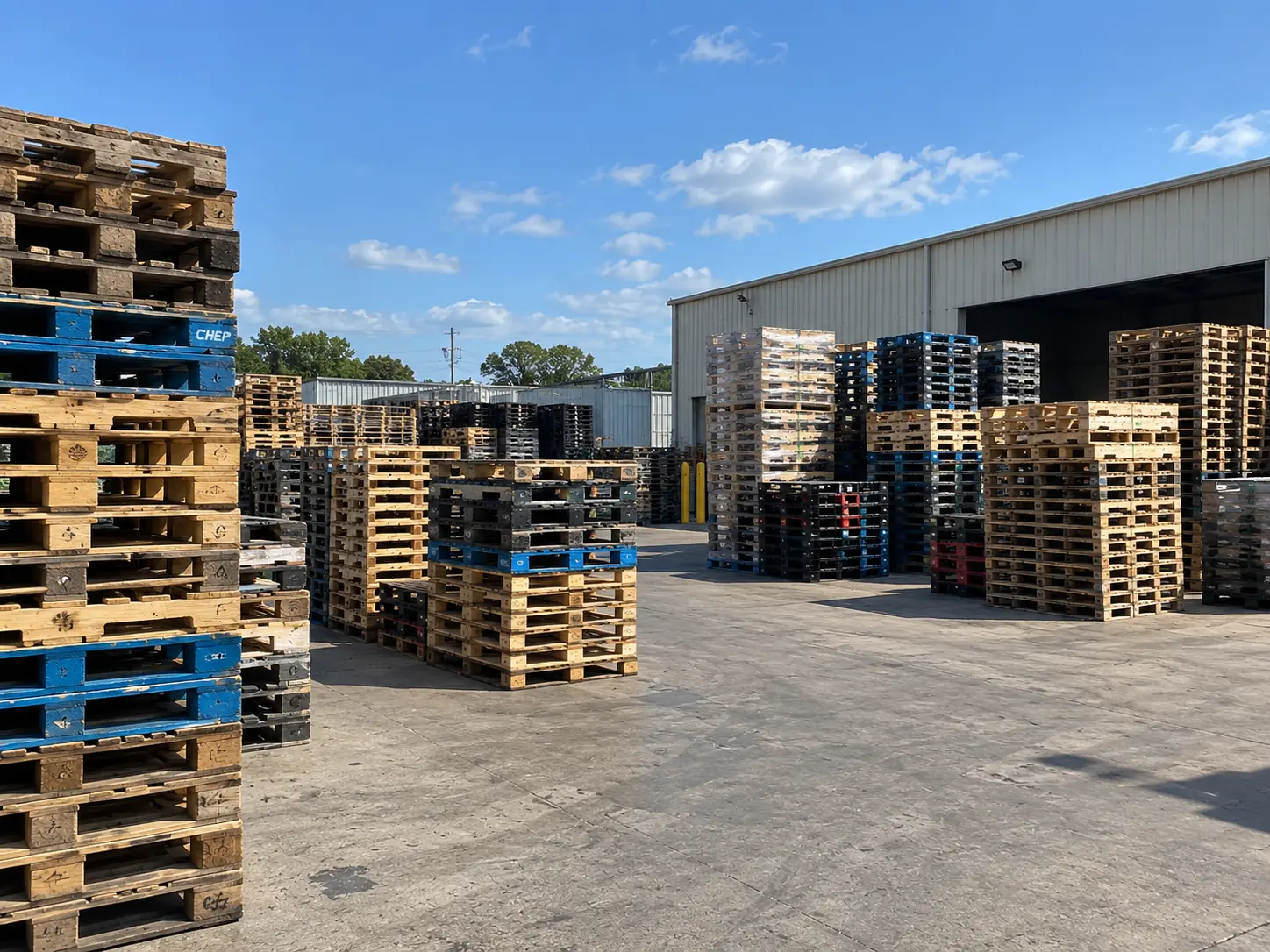
We buy, repair, sell, haul and recycle used pallets — and everything that can be made from them afterwards. Ninety-six percent of the timber that arrives at our Evendale yard leaves it still doing the job it was milled for.
One form, one business day, one written answer with pricing, freight and piece counts broken out separately. We have no phone line — which is exactly why our written quotes are unusually thorough.
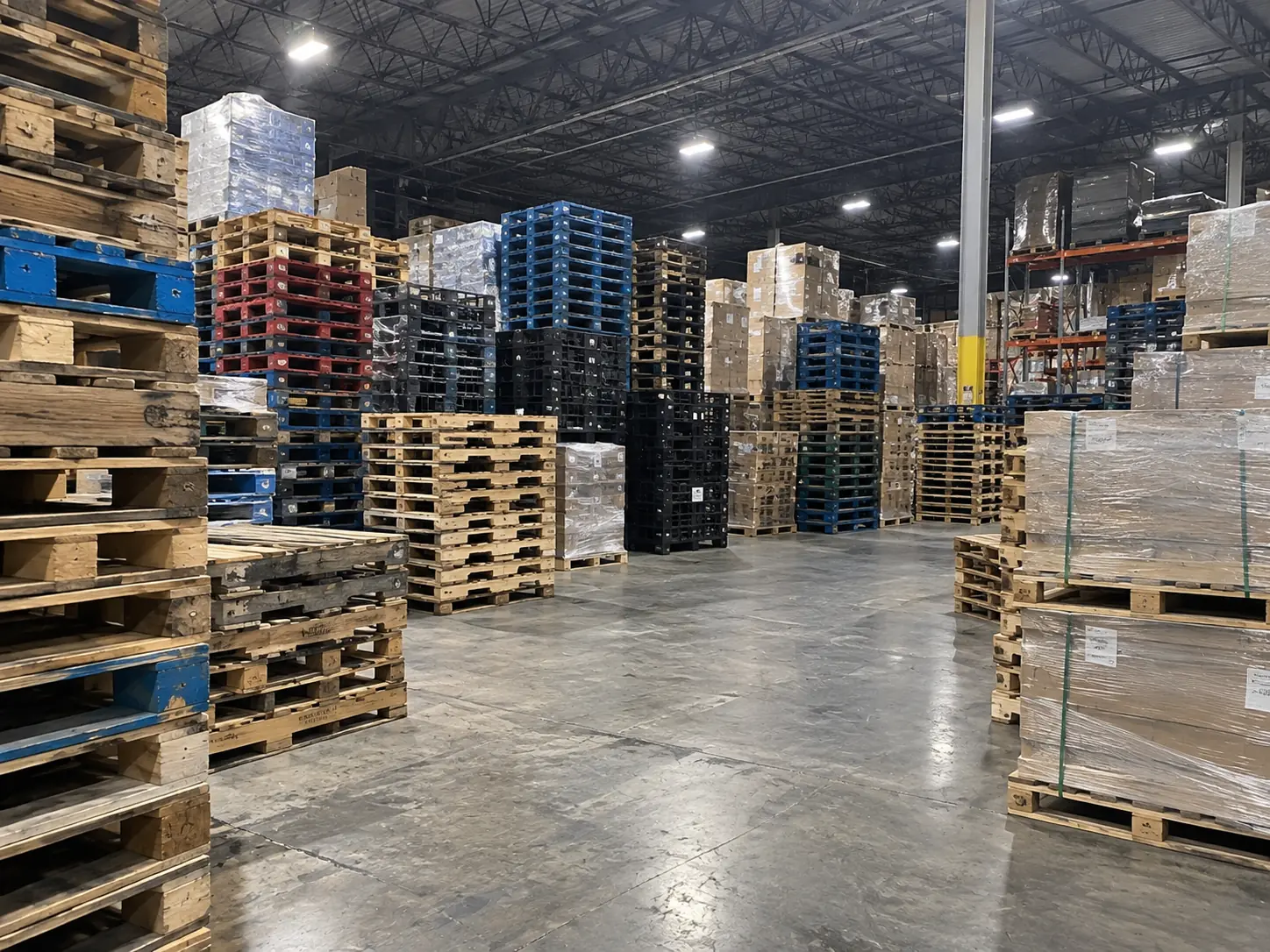
Most operations use four vendors to do what one closed loop should: somebody to supply, somebody to haul away, somebody to repair, and somebody nobody remembers hiring. Every service below exists so you can stop doing that.
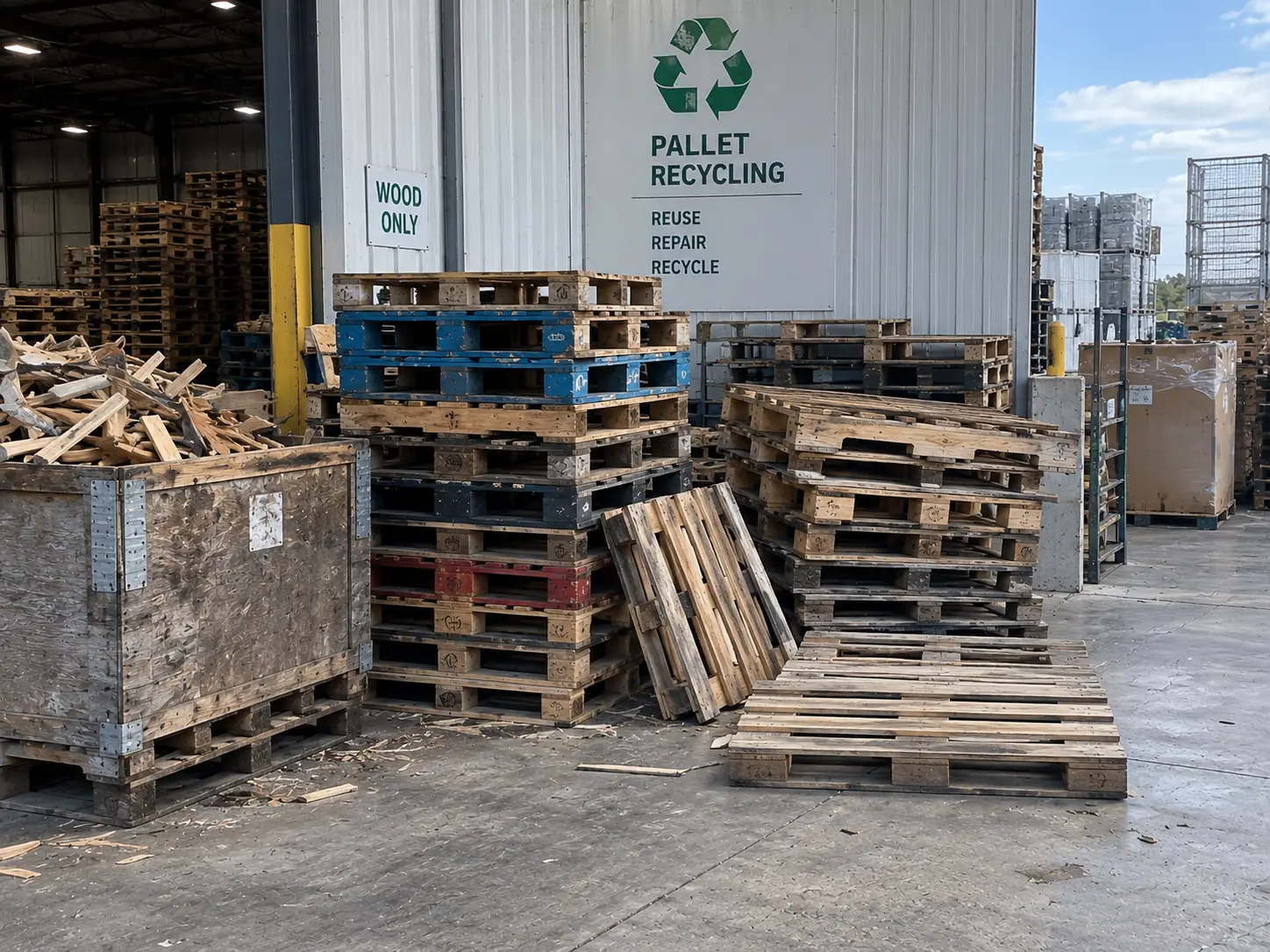
Grinding wood is fast, easy to sell and destroys roughly ninety percent of the value locked in a pallet. Every stage we can delay the grinder by is a stage a board keeps doing what it was milled for.
See the full line, step by stepInspected, graded, banded and shipped. No tools touched it, no energy spent on it.
One stringer or two boards replaced at a bench with harvested lumber. Back to #1 or #2 grade.
Frame beyond saving, lumber is not. Boards stripped, de-nailed, stacked as repair stock.
Recovered components rebuilt on a jig into a smaller footprint. This is how odd sizes stay affordable.
Ground, double magnet-separated, screened into landscape mulch, animal bedding and boiler fuel.
Contaminated units and non-wood debris only — reported to you by weight rather than quietly absorbed.
Move the slider to your monthly volume and watch what a closed loop is actually worth — in carbon, in timber, in trees and in landfill space. Every constant is published, so you can argue with our arithmetic rather than take our word for it.
Equivalent to taking 138 average US passenger vehicles off the road for a year. Every constant used here is published on our carbon methodology page so you — or your auditor — can check the arithmetic rather than trust it.
From a #2 economy stringer that will carry scrap across a yard to a jig-built export crate with a kiln record attached to it. Same yard, same graders, same written specification.
A, B and #2 grade hardwood, inspected board by board.
View Built to orderBuilt to print when reuse genuinely will not do.
View In stockThe North American standard, always in stock.
View Made to specForty-plus footprints, plus anything you draw.
View ExportKiln-stamped and compliant for export.
View ReusableReconditioned and new rackable, nestable and hygienic.
View Add-onsCollars, caps, slip sheets, top frames and corner board.
View ContainersReusable shipping containers and one-way crates.
View Studio lineFurniture, planters and retail fixtures from retired wood.
ViewPallet size charts are tables of numbers that nobody can picture. Ours draws the footprint in your browser, ghosts a 48×40 GMA underneath it for comparison, and shows you the stringers, the notches and a fork tine at the same scale. Switch to millimetres if that is the language your drawing speaks.
The greenest pallet in the world is the one already standing in your yard.
We are not in the business of telling you to buy more. We are in the business of making sure the wood you already own does four more trips before anybody thinks about a saw.
That is why our quotes break freight out separately, why we tell you when a new build is genuinely the right answer, and why we publish our carbon arithmetic instead of rounding it upward. Seventeen years in, the customers who stayed are the ones who checked.
Transport is the dominant emissions cost in a recycled pallet’s life, which is why we would rather be genuinely good inside 250 miles than nominally national.
No gated whitepapers and no lead-capture walls. If it is useful, it is on the page.
A, B, #1 and #2 — what each grade permits, what it rejects, and which one your application needs.
Read Compliance · 9 minHeat treatment, the IPPC wheat stamp, country requirements and the failure modes that strand containers.
Read Specification · 7 minOak, maple, poplar, pine and spruce compared on strength, weight, cost and service life.
Read Specification · 7 minTwo construction philosophies, two handling behaviours, and how to tell which one you actually need.
Read Economics · 9 minOwned whitewood, pooled rental and one-way programmes compared on real total cost.
Read Engineering · 10 minStatic, dynamic and racked ratings, creep, overhang penalties and how to specify without guessing.
ReadThe yard is open to customers Monday to Friday, 7:00 AM to 5:00 PM, and Saturday mornings. Walk the stacks, pick up your own bundle, or just see how a grading line actually works.
Mounted at both grading stations since 2011. Reproduced in full on this site so you can hold us to them or copy them into your own receiving spec.
A lot with zero rejections was sorted, not graded. We print the number we pulled.
A combined unit price hides the only cost you can actually change.
Twelve months of measured intake, moisture, grading outcomes and recovery streams. Almost none of it exists anywhere else.
Two, after customers' consultants challenged them. A methodology that only improves is not being checked.
Fast, cheap, and it puts a hard steel edge into a structure that will be handled thousands of times.
The jig is ours to build and yours to use for as long as the account is active. If you leave, we send you the drawing.
Grade right-sizing costs us margin and it is the reason most of our accounts are repeat accounts.
Removed in 2016 because every serious dispute in seven years was a verbal agreement remembered two ways. Everything here happens in writing.
Measured, not estimated. Everything below was counted on our intake belt, weighed on our scale house or logged by our route desk between September 2025 and August 2026, and the full record is published.
| Measure | Twelve months to August 2026 |
|---|---|
| Pallets across the weighbridge | 1,416,400 |
| Trailer movements dispatched | 5,965 |
| Mean direct reuse, no tool used | 55.5% |
| Sent to a repair bench | 27.0% |
| Dismantled for board harvest | 9.1% |
| Remanufactured into another footprint | 5.2% |
| Recovered as fibre products | 2.9% |
| To licensed disposal | 0.5% |
| Ferrous baled and sold to scrap processors | 1,186 tons |
| Mean backhaul rate | 78.2% |
| Mean inbound moisture content | 17.1% |
| Wettest month | April, at 22.1% |
| Best month for direct reuse | July, at 59.1% |
| Worst month for direct reuse | April, at 51.4% |
| Most common rejection reason | Cracked stringer, 34.2% of all rejections |
| Most common repair | One or two deck boards, 48.6% of all repairs |
| Dominant footprint in intake | 48 × 40 GMA, 71.3% |
| Dominant species in intake | Red and white oak, 38.4% |