Four 55-gallon drums
The defining application. Four drums at roughly 23 in diameter occupy 46 inches square — a clean fit with clearance on every side.
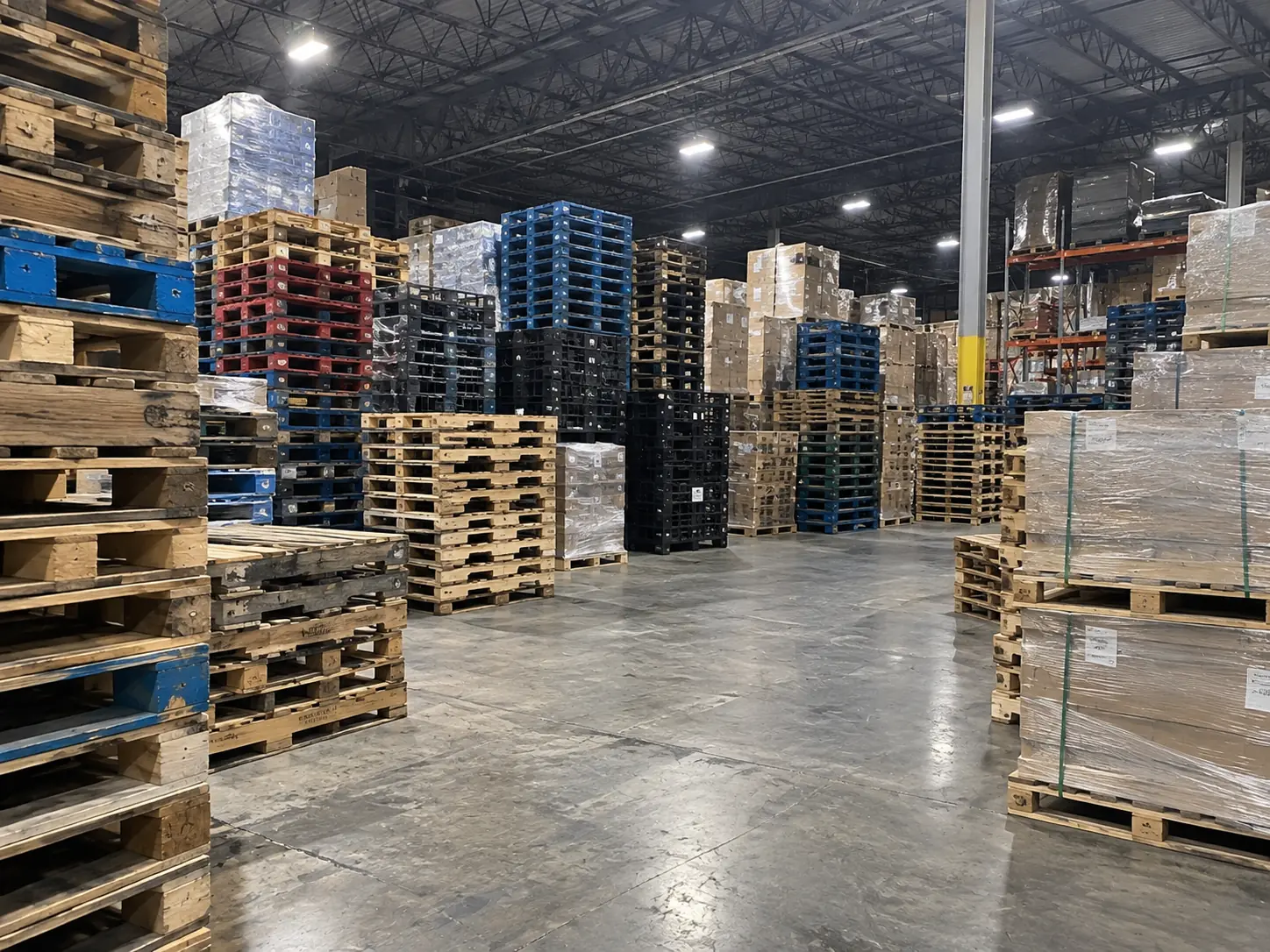
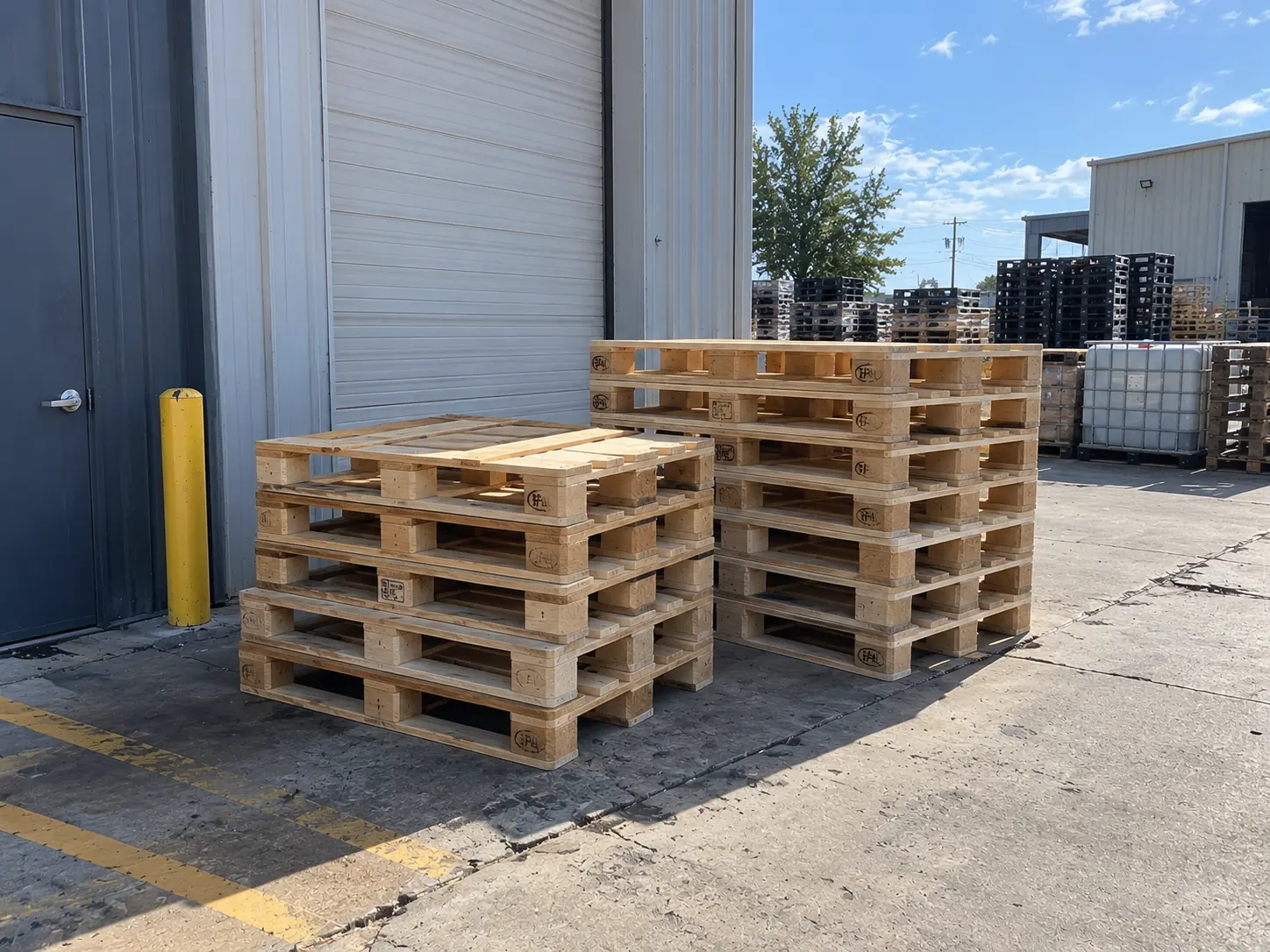
The 48 × 48 inch square pallet (1219 × 1219 mm) is the four-drum footprint. Four 55-gallon drums seat square on it with no overhang, and the extra 8 inches of depth over a GMA makes it the default for bulk bags, cable reels and any load that needs a wider base than a 48 × 40 provides. It typically weighs 42–55 lb and carries 3,000 lb dynamic.
Send the details and a named person at the Evendale yard replies within one business day with pricing, freight and a piece count — in writing.
The defining application. Four drums at roughly 23 in diameter occupy 46 inches square — a clean fit with clearance on every side.
A one-ton bulk bag slumps outward when filled. A 48 × 48 base keeps the slump inside the footprint instead of over the edge.
Large reels need a wide, stable base and often centre-of-gravity support that a rectangle cannot give.
Square bases suit square equipment. Frequently built as heavy-duty solid deck for this use.
Stacked tyres and rolls of material load more stably on a square deck than a rectangular one.
Increasingly common for battery modules and inverter assemblies with wide, heavy, evenly distributed loads.
| Attribute | Value |
|---|---|
| Footprint | 48 × 48 in (1219 × 1219 mm) |
| Height | 5.75 in (146 mm) |
| Empty weight | 42 – 55 lb |
| Top deck boards | 8 (tight-laid available) |
| Bottom deck boards | 5 |
| Stringers | 3, double-notched; 4 available for heavy service |
| Static capacity | 6,000 lb |
| Dynamic capacity | 3,000 lb |
| Racked capacity | 2,200 lb |
| Per 53-ft trailer (empty) | ~480 |
| Floor positions per 53-ft trailer | 24 |
Two 48 × 48 pallets side by side measure 96 inches, the same as two 48 × 40s, so trailer width is unaffected. The cost is depth: 24 positions instead of 28, a 14% reduction in positions per trailer. For dense loads that are weight-limited rather than volume-limited, this costs nothing at all. For light loads it matters, and a 48 × 40 with proper blocking may be the better answer.
A flexible intermediate bulk container has no rigid structure. Filled, it becomes a column of material held by fabric, and it spreads under its own weight until fabric tension stops it. The spread continues for hours after filling as the contents settle, and increases again in transit as vibration compacts the load.
| Problem | Cause | Fix |
|---|---|---|
| Fabric tearing along one edge | Overhanging fabric taking the full load over a sharp board edge | Larger footprint; eased deck edges |
| Abrasion in stripes across the base | Fabric sagging into 3.5-in deck gaps | Tight-laid or solid deck |
| Bag contacting the rack beam | Slumped bag wider than the bay opening | 48 × 48 and a 108-in beam |
| Crushing when stacked | A slumped bag has no corners to carry load | Top cap, or do not stack |
| Two lift loops taking all the strain | Bag sitting unevenly on an undersized pallet | Correct footprint; restraint frame for tall bags |
Two 48 × 48 pallets side by side occupy 96 inches — the same as two 48 × 40s — so trailer width is unaffected. The cost is depth: 24 floor positions instead of 28, a 14% reduction.
| Equipment | 48 × 40 positions | 48 × 48 positions | Difference |
|---|---|---|---|
| 53-ft dry van | 28 | 24 | −14% |
| 48-ft dry van | 24 | 22 | −8% |
| 40-ft container | 20 – 21 | 18 | −12% |
| 45-ft high cube | 24 – 25 | 22 | −10% |
| 26-ft box truck | 12 | 10 | −17% |
For dense loads that gross out before they cube out, this costs nothing at all — you were weight-limited anyway. For light, bulky freight it matters, and a 48 × 40 with proper blocking may genuinely be the better answer. Establish which constraint you actually hit before optimising the wrong one.
Specify four stringers for drum service. Four drums at 500 lb each is 2,000 lb concentrated on four small contact circles, not spread evenly — and a three-stringer 48 × 48 spans further between supports than a 48 × 40 does, so it can be weaker in the centre despite being larger.
The 48 × 48 Square in plan and elevation, rendered at true proportion against a ghosted 48×40 GMA. Switch units if your drawing speaks millimetres.