A window gets missed
Routes accumulate variability across stops. Our rule is that you hear from the coordinator before you hear from the driver, and before the window closes — not after.
Eight steps from your first email to a graded pallet back on a trailer: you write, we quote in writing, the right truck arrives, everything is counted and weighed, a person segregates contamination at the belt, the five-stage cascade decides each pallet’s fate, finished units are graded and banded with a written grade sheet, and you get a monthly statement of where every pound of it went. A core collected Monday is usually back out on a trailer by Friday.
Volume, postal code and — if you have pallets to sell — a photograph of the pile from two angles. That is genuinely all we need to start.
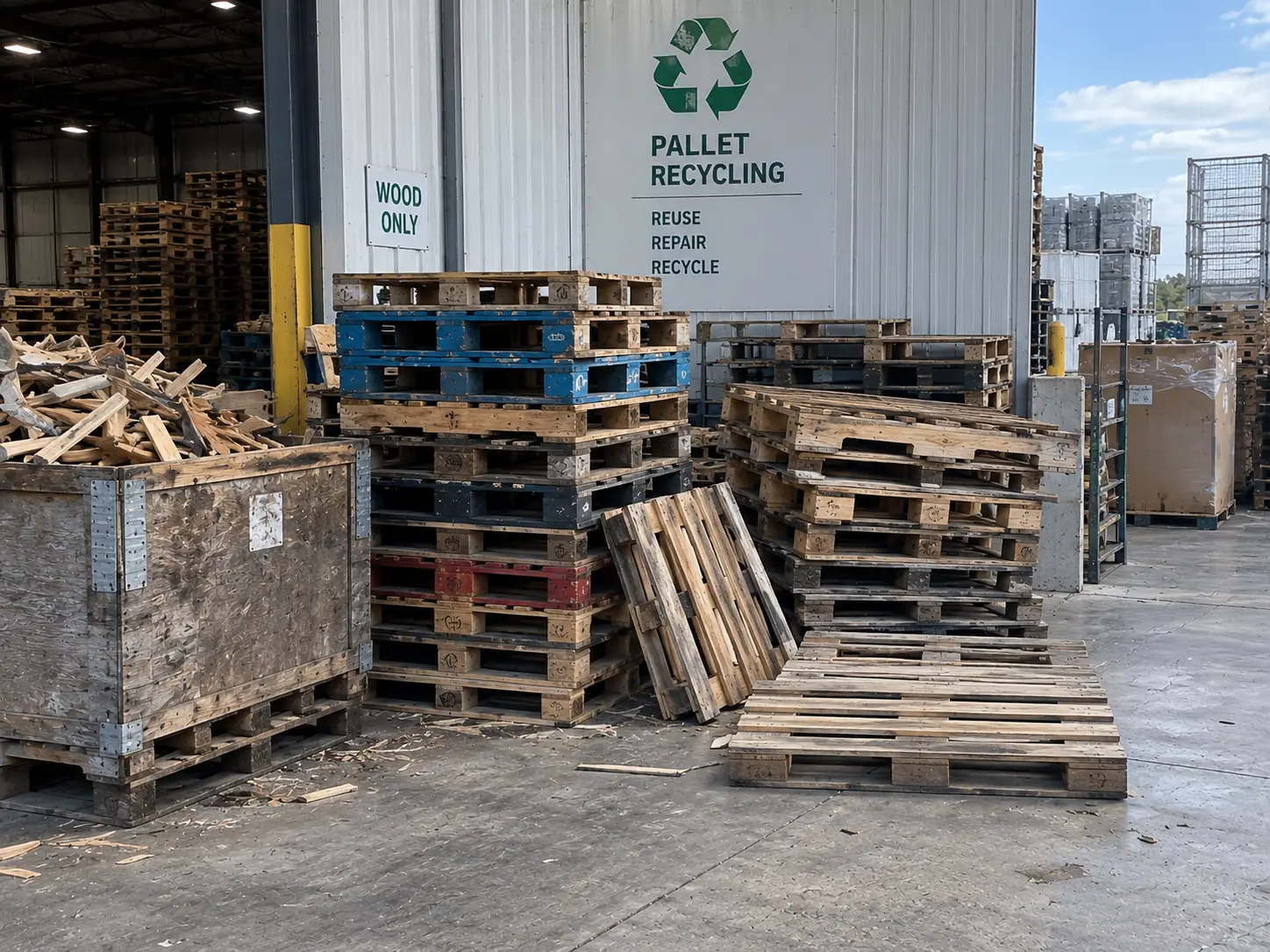
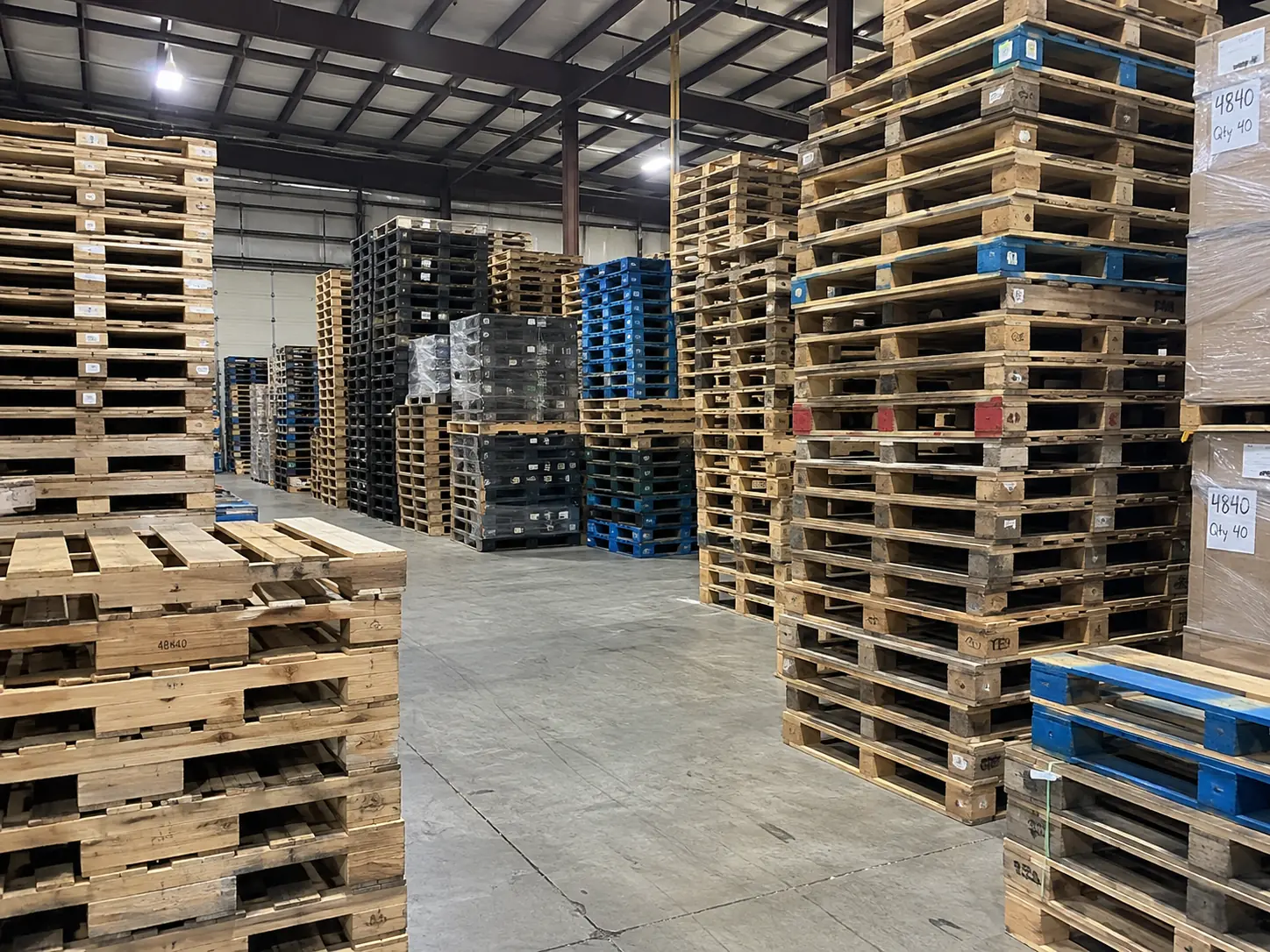
An email, or any form on this site. Volume, postal code and a photograph of the pile tell us more in thirty seconds than a phone call does in ten minutes — which is one reason we do not have a phone.
Within one business day: rate per core or per load, the pickup window we can hold, and the equipment we will bring. For purchases, unit price and freight are separate lines so you can see both.
53-ft dry van for dock-height volume, flatbed with straps for outdoor piles, 26-ft liftgate box truck for tight urban access. Getting this wrong is the most common reason a collection fails, so we ask before we dispatch.
Our driver counts with your receiving contact and both parties sign the tally. The trailer is weighed at our scale house on arrival. Weight in and weight out is what makes everything downstream auditable.
A person — not a sensor — pulls painted, chemically stained and MB-stamped wood before it reaches any downstream process. Everything else enters the cascade.
Reuse, repair, board harvest, remanufacture, fibre. Each outcome is tested in descending order of value, so nothing is ground that could have been repaired and nothing is repaired that was already sound.
Finished units are graded against posted rejection criteria, banded in stacks of 12 to 25 and loaded with a written grade sheet and piece count attached to the bill of lading.
Monthly: tonnage by destination, diversion rate, estimated CO₂e, core credits applied. Then the loop runs again — and on standing accounts, the truck that delivers is the truck that collects.
Grinding is fast, easy to sell and destroys roughly ninety percent of the value locked in a pallet. Every stage above the grinder is a stage a board keeps doing what it was milled for.
Our recycling serviceCleaned, inspected, graded, banded. No tools touched it.
One stringer or two boards, replaced with harvested lumber at a bench.
Frame gone, lumber not. Boards stripped, de-nailed and stacked as repair stock.
Recovered components rebuilt on a jig into a different footprint.
Ground, double magnet-separated, screened into mulch, bedding or boiler fuel.
Contaminated units only — reported to you by weight.
Recycling wood well means resisting the urge to grind. This table is why: each step down the cascade destroys a large fraction of the value and the carbon benefit still held in the unit.
| Stage | Share of intake | Energy input | Value retained | Carbon horizon |
|---|---|---|---|---|
| Direct reuse | ~55% | Inspection labour only | Almost all | Another full service life |
| Repair | ~27% | Two to four bench minutes | Most | Another full service life |
| Board harvest | ~9% | Teardown and de-nailing | Substantial — lumber, not a pallet | Extended through repairs elsewhere |
| Remanufacture | ~5% | Teardown, trim, jig build | Substantial — a new pallet from old wood | Another full service life |
| Fibre recovery | ~3% | Grinding, screening, colouring | Small | Years, in mulch. Immediate, as fuel. |
| Landfill | <1% | Haulage only | None | Methane — worse than burning it |
That last row is the one that surprises people. Buried wood decomposes anaerobically and produces methane, which is a far more potent greenhouse gas than the carbon dioxide the same wood would have released as fuel. Landfilling wood is not a neutral outcome — it is the worst one available.
| Step | Elapsed time | What can delay it |
|---|---|---|
| Your email to a written quote | Within one business day | Missing postal code or volume — the two facts we cannot price without |
| Quote to collection window | 2 – 5 business days inside the core radius | Site access constraints we discover late |
| Collection to weighbridge | Same day | Nothing, usually |
| Intake to graded result | 3 – 10 business days | Volume; spring moisture adds drying time |
| Graded to banded and available | Same day as grading | Height sorting for automation adds a pass |
| Standing stock to your dock | 24 – 72 hours | Split drops; we will ask about consolidating |
| Heat treatment | +5 – 7 business days | Kiln scheduling; species and moisture set the cycle |
| Custom prototype | 5 – 7 business days | Load data we are still waiting for |
| Custom production run | 10 – 15 business days | Species availability; kiln time if treated |
| Monthly diversion statement | First week of the following month | Nothing — it is built from tickets already collected |
Published because every supplier describes the happy path and almost none describe the other one.
Routes accumulate variability across stops. Our rule is that you hear from the coordinator before you hear from the driver, and before the window closes — not after.
Raise it within three business days with photographs in situ. Our practice is to collect and replace rather than dispute. We would rather absorb a bad load than win an argument about one.
The signed tally is the operative record, which is why both parties sign it at the point of collection rather than reconciling later.
Segregated, weighed, reported to you, and handled through a licensed route. It appears on your statement as a named line, not a rounding.
We stop and ask. We will not take them — doing so creates a liability on your account that you did not agree to.
This is on us for not asking. It is why the coordinator has eleven questions and why two photographs answer half of them.