We started with one bay and a dismantling bar
In short
Pallets Recycle began in 2009 in a single leased bay off Evendale Drive, buying broken pallets nobody else wanted and repairing them by hand. Seventeen years later the same address handles roughly 1.4 million pallets a year across buying, repair, remanufacture, recycling, freight and a small studio line — and ninety-six percent of the wood that comes through the door leaves still doing the job it was milled for.
Work with us
Whether you have pallets to sell, pallets to buy, or a pile that has become a safety conversation — the same form reaches the same people.
The problem we noticed first
In 2009 there was a manufacturer in Sharonville paying a waste hauler to take away pallets, and a distributor four miles up the road paying a broker to bring pallets in. Both invoices were being signed every month by companies that had never spoken to each other. That gap — paying at both ends of the same piece of wood — is the entire reason this business exists.
We started by doing the least glamorous half: collecting. One box truck, a dismantling bar, and a standing offer to take away anything wooden. The repairs came second, because once you have a pile of broken pallets in a bay, it becomes obvious very quickly how many of them are not actually broken.
What we learned in the first three years
Three things, all of which still shape how we operate. The first is that most pallets written off as scrap need one deck board. The second is that a truck carrying wood one direction and air the other has doubled the cost and the emissions of everything on it. The third is that the industry’s vocabulary is unreliable — one yard’s A grade is another’s B — and that every dispute we have ever had traced back to somebody assuming a word meant what they thought it meant.
So we wrote our rejection criteria down and posted them at both grading stations. We built dispatch around a single question asked before any load is assigned: what comes back? And we stopped guessing.
Why there is no phone number
This surprises people, so it is worth explaining properly. We took our phone line out in 2016. Not to be difficult, and not to save money — but because the pattern of every serious problem we had in the first seven years was identical: a verbal agreement remembered differently by two people a month later.
Everything at Pallets Recycle now happens in writing. Quotes, confirmations, tally sheets, treatment records, complaints. It means our written quotes are unusually detailed, because they have to carry the whole conversation. It means you can forward a quote to your finance team without retyping it. And it means that when something goes wrong — which it does — we can both read exactly what was agreed rather than argue about it.
Some customers hate it for the first month. Almost none of them go back.
What we will not do
- We do not metal-plate a cracked stringer. It is fast, it is cheap, and it puts a hard steel edge into a wood structure that will eventually catch on a conveyor or scratch a painted panel.
- We do not grind chemically treated, painted or methyl-bromide-stamped wood into any product sold for landscape or animal use.
- We do not quote freight inside a unit price to make the unit price look better. It is a separate line because it is a separate cost, and hiding it prevents you from making the decision that actually saves money.
- We do not claim national coverage. Transport is the dominant emissions cost in a recycled pallet’s life, and a pallet trucked 400 miles undoes much of the point of recycling it.
- We do not sell you a higher grade than the application needs. It is the most common and most expensive habit in pallet purchasing and it is easy money for suppliers who stay quiet about it.
Where we are now
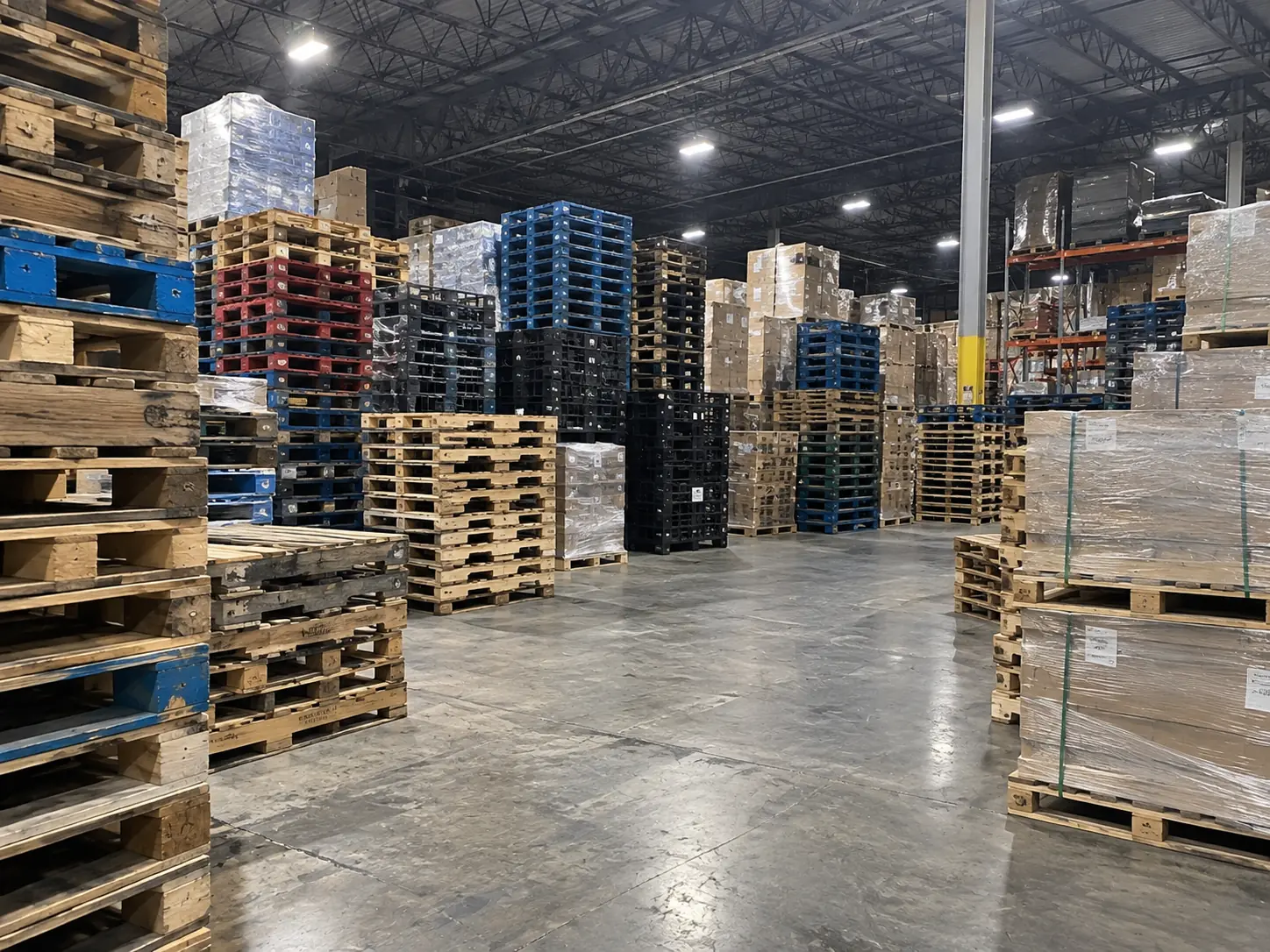
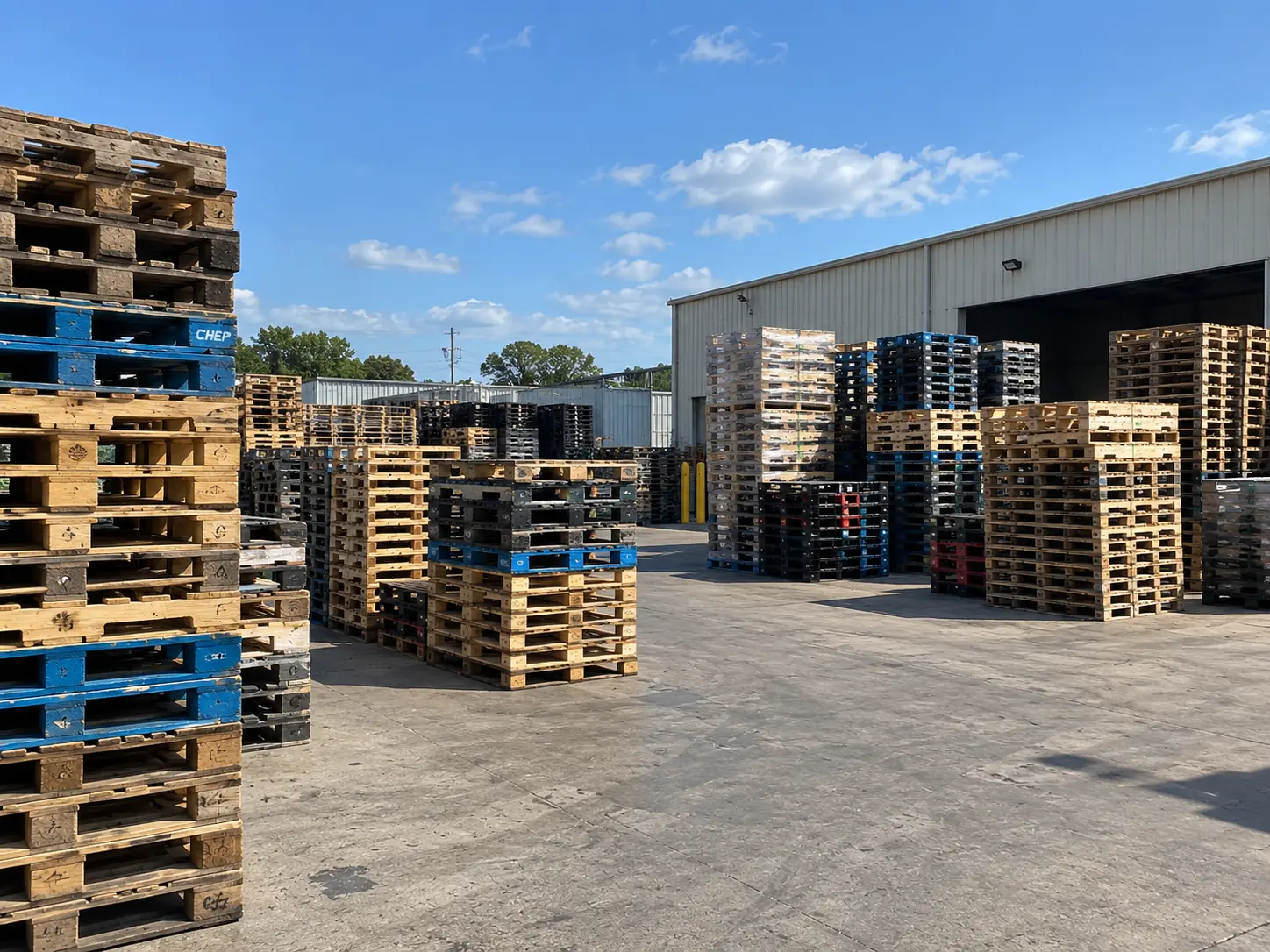
10400 Evendale Dr, Cincinnati, OH 45241 — the same street, a much larger footprint. Two grading lines, a repair bench floor, a dismantling line with magnetic separation on both the discharge and the grinder outfeed, a kiln for ISPM-15 treatment, a colouring and screening plant for landscape products, and a studio at the back where wood too old and too good to grind becomes something else.
Roughly 120 trailer movements a week. Seventy-eight percent of our outbound miles carry a paying return load. Four hundred and eighty active collection sites across Ohio, Kentucky and Indiana. And a zero-landfill commitment that we report on by weight rather than by adjective.
Seventeen years and we have still never met a pallet that was entirely broken.
There is always a board worth keeping. Usually there are twenty.
That is not sentiment, it is the economics of this industry. Grinding is the fastest way to turn a high-value object into a low-value one, and almost every yard that struggles does so because it grinds too early. Everything we have built — the repair benches, the harvest line, the jigs, the studio — exists to delay the grinder by one more stage.
The eleven things we measure, and why each one exists
Every measure below was added because something went wrong first. They are published because a company that tells you what it measures is telling you what it can be held to.
| Measure | Why it exists | Where it shows up for you |
|---|---|---|
| Rejection rate per lot | A lot with zero rejections was sorted, not graded | Printed on your grade sheet |
| Rework rate per bench, per shift | A bench measured on units per hour will produce units per hour | Fewer repeat failures at your dock |
| Inbound and outbound weight | Piece counts flatter; the disposal stream is the heaviest material | Auditable diversion reporting |
| Mean inbound moisture | Wet wood grades worse and is worth less | What we can pay for your cores |
| Backhaul rate | A truck carrying air one way has doubled cost and emissions | Round-trip pricing |
| Window adherence | A missed window that nobody warned you about is the real failure | You hear from the coordinator, not the driver |
| Shiner escapes | One proud nail is a corrective action in automotive | Separate final inspection pass |
| Contamination caught at the belt | What reaches the grinder decides what is in the mulch | Landscape product we will sell to a school |
| Ferrous recovered per pallet | We had been using a published average that was wrong | A published constant we revised upward |
| Grade split delivered against specification | Grades drift back upward silently | Visible at your quarterly review |
| Cost per shipment | Unit price is the smallest part of what pallets cost | The trend line that matters |
How we price, stated openly
Pricing in this industry is opaque by convention rather than by necessity. Here is ours.
- Unit price and freight are always separate lines. A combined number makes it impossible for you to see that a full load, a shared route day or a paired collection would change it.
- Quotes are valid five business days, and reserved lots are held for the same period. Recycled pricing moves with core supply, which is seasonal, so we do not issue open-ended pricing.
- Recycled quotes include photographs of the actual reserved lot. Not stock imagery, not a similar lot.
- We will tell you when a lower grade does the same job. It costs us margin and it is the reason most of our accounts are repeat accounts.
- We will tell you when a new build is genuinely right, even though the recycled unit is easier for us to supply.
- If you generate cores at the site we deliver to, we quote the combined rate whether or not you ask for it.
- Beyond roughly 400 miles, freight exceeds the wood. We say so and frequently suggest somebody closer.
- No tooling charges on custom work. The jig is ours to build and yours to use for as long as the account is active.
Who decides what, and who you write to
| Decision | Who owns it | How to reach it |
|---|---|---|
| What grade a unit is | The grader at the station, against posted criteria | Grade sheet names the station and shift |
| Whether a repair holds | The bench, sampled by the floor lead | Rework findings reported monthly on programmes |
| What contamination is pulled | The person at the intake belt — deliberately not automated | Tonnage reported back to you by weight |
| Which day your route runs | The route coordinator, built Thursday for the following week | Named contact on standing accounts |
| Whether a window will be missed | The route coordinator, who tells you before the driver does | Email, before the window closes |
| What a custom build is specified as | Jointly — your load data, our calculation, your sign-off at gate five | Drawing issued before any jig is built |
| What a published constant is | Open to challenge. Two have been revised after customers pushed back. | Write to us with the argument |
| Everything else | One inbox, one team, one business day | info@palletsrecycle.com |