Stringer vs Block Pallets
In short
A stringer pallet uses three long boards on edge to support the deck, giving two-way or partial four-way fork entry. A block pallet uses nine solid blocks, giving true four-way entry and better handling by pallet jacks from any side. Stringers dominate North America because they are cheaper; blocks dominate Europe and automated systems because they are more consistent and stronger.
Quote: Stringer vs Block Pallets
Send the details and a named person at the Evendale yard replies within one business day with pricing, freight and a piece count — in writing.
Anatomy of each
Stringer construction
Three (occasionally four) lengths of lumber on edge, typically 1.5 × 3.5 inches, running the length of the pallet. Deck boards are nailed across them. Fork entry is naturally two-way — along the stringers. Notching the outer stringers creates partial four-way entry, but the notch is a deliberate weak point and entry from that direction carries less load.
Block construction
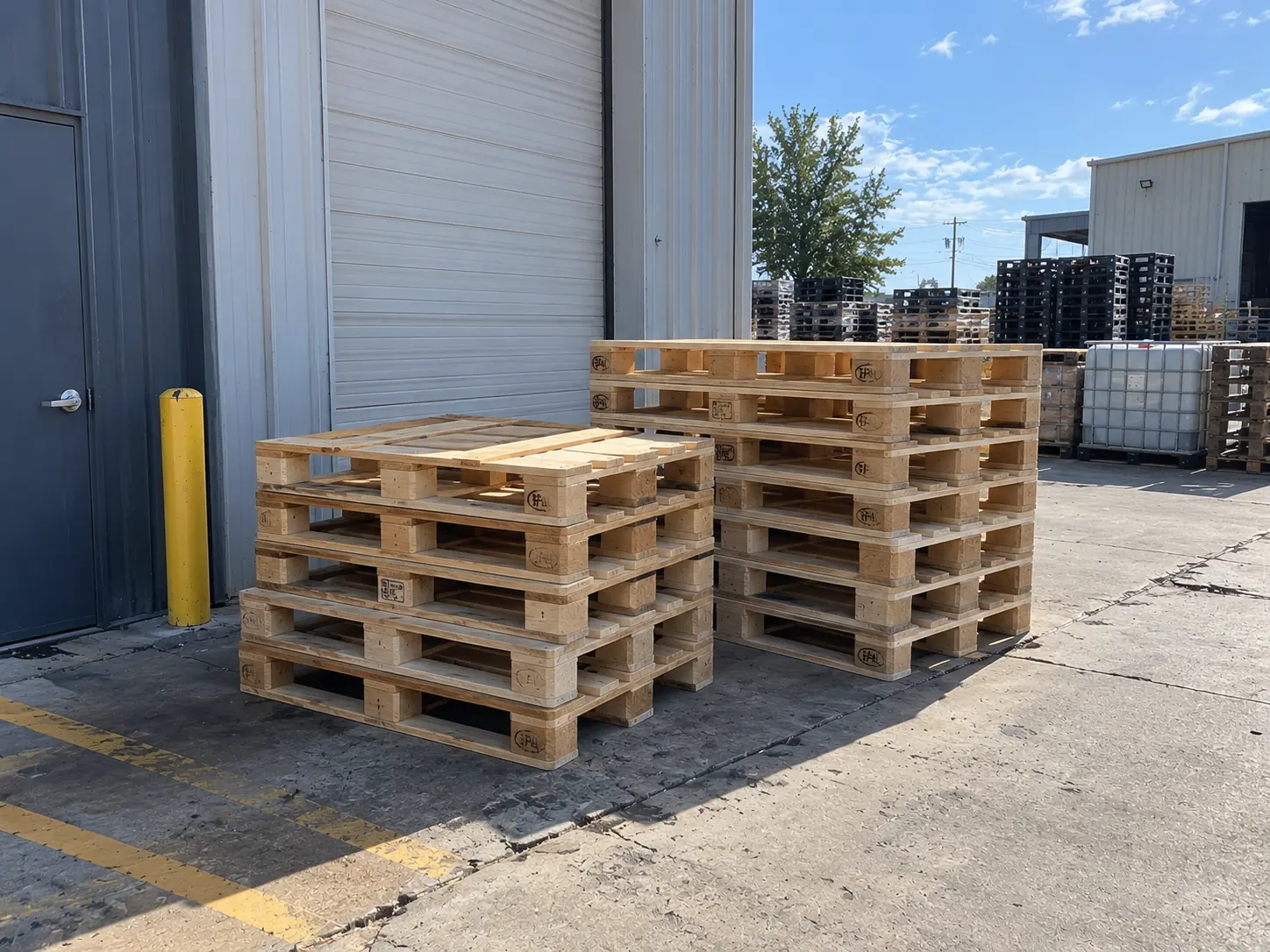
Nine solid blocks in a 3 × 3 grid, joined by top deck boards above and bottom bearer and deck boards below. Fork entry is genuinely equal on all four sides because the openings are identical. The structure is more rigid, more consistent, and considerably more expensive to build.
Side by side
| Factor | Stringer | Block |
|---|---|---|
| Fork entry | Two-way, or partial four-way if notched | True four-way, equal strength all sides |
| Pallet jack access | Two sides reliably | All four sides |
| Relative cost | Baseline | 30 – 60% higher |
| Weight | Lighter | Heavier |
| Racked strength | Good along stringers, weak across | Consistent in both directions |
| Automation suitability | Fair — notch geometry causes hang-ups | Excellent — consistent openings |
| Repairability | Excellent — plugs, companions, board swaps | Good — blocks replaceable |
| Service life | 4 – 7 trips typical | 10+ trips typical |
| Dominant region | North America | Europe, Asia, global automation |
| Recycled availability | Abundant | Limited in North America |
The notch problem
Notching is the compromise that makes a stringer pallet almost four-way. Two 9-inch-wide, 1.5-inch-deep notches are cut into the outer stringers so a fork can enter from the 48-inch side. Structurally, this removes material at precisely the point where bending stress from a racked load is highest. A notched stringer is roughly 30 to 40% weaker in bending than an unnotched one.
- Enter from the open (40-inch) side wherever possible — it is the strong direction
- Never rack a notched stringer pallet across the notch direction without checking the rating
- A cracked stringer almost always fails at a notch; this is where to inspect first
- If your operation genuinely needs four-way entry under load, you need block construction, not notching
Notch geometry, and what it costs
Notching is the compromise that makes a stringer pallet almost four-way. It is worth seeing the actual geometry, because the strength loss is a direct consequence of removing material at the point of highest bending stress.
| Parameter | Standard GMA notch |
|---|---|
| Stringer section | 1.5 × 3.5 in nominal |
| Notch width | 9.0 in |
| Notch depth | 1.5 in |
| Remaining stringer depth at notch | 2.0 in |
| Notches per outer stringer | 2 |
| Notch position | Set in from each end, centred on fork entry |
| Section modulus reduction at notch | Roughly 67% of original |
| Practical bending strength loss | 30 – 40% in that direction |
- Enter from the open 40-in side wherever possible — that is the strong direction.
- In racking, run the stringers across the beams so each beam supports the full uncut depth.
- A cracked stringer almost always fails at a notch. Inspect there first and you will usually be right.
- If your operation genuinely needs four-way entry under load, you need block construction, not deeper notching.
Which construction your handling equipment actually wants
| Equipment | Prefers | Why |
|---|---|---|
| Counterbalance forklift | Either | Enters from the open side; notch geometry rarely matters |
| Reach truck | Either, stringer acceptable | Enters along the stringers in most rack configurations |
| Manual pallet jack | Block, clearly | Needs consistent openings between bottom deck boards on all four sides |
| Powered pallet truck | Block | Same reason, and the wheels need a chamfer to climb |
| Roller and chain conveyor | Block | Consistent bottom-deck geometry; notches cause hang-ups |
| AS/RS and shuttle | Block | Indexes on height and bottom-deck consistency |
| AGV, under-pallet lift | Block | Predictable ground clearance and board placement |
| Clamp truck | Neither — it does not use the pallet | But it will crush deck boards on adjacent stacks |
| Bar lift / sling | Winged stringer | Needs the deck overhang to grip |
The pattern is clear: anything that engages the pallet from beneath or from the side wants block construction, and anything that enters with forks from an open face is largely indifferent. That single distinction explains why Europe standardised on block pallets and North America did not — and why automation projects here so often surface a pallet problem that was always present.