Reference

Frequently asked questions

In short

46 answers across six areas: buying pallets, selling and recycling yours, specification and grades, delivery and logistics, sustainability, and our services. Written plainly, without marketing language, and updated whenever somebody asks something we have not covered.

Not answered here?

Put your question in the message field. If it is useful to more than one person it usually ends up on this page, with nothing identifying you attached to it.
We reply by email only — no marketing list.

US or Canada, 10 digits — format as (513) 555-0142.

US ZIP like 45241, or Canadian like K1A 0B1.

Required fields are marked *. Your details go to our Evendale team and nowhere else — see the privacy policy.

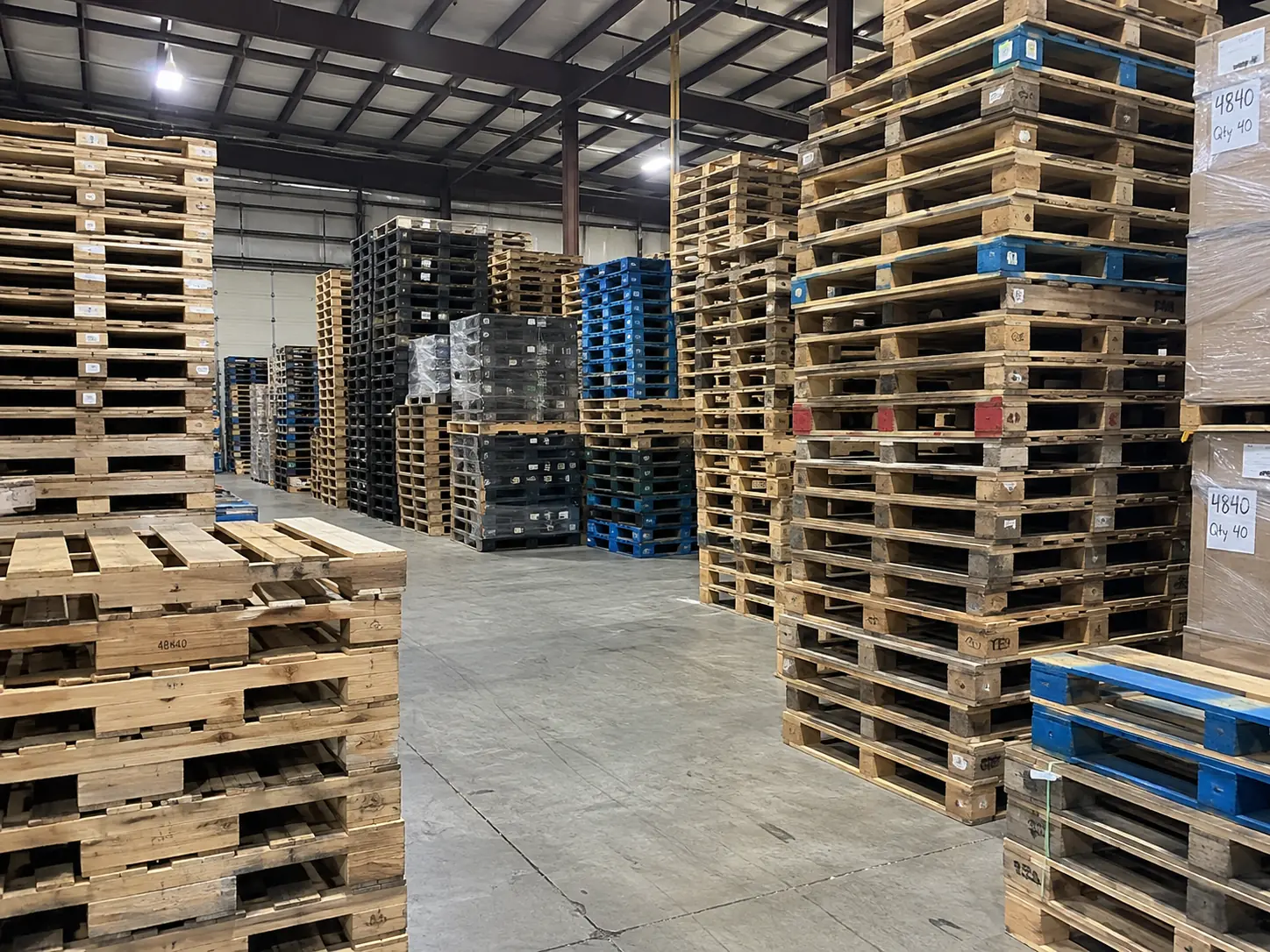
An aisle inside the Evendale warehouse, lined with banded stacks of recycled wood pallets carrying lot tags, alongside stacks of black and blue plastic pallets.
Graded stock, banded and lot-tagged. A, B and #2 are held apart so what leaves the yard is what arrives at your dock.
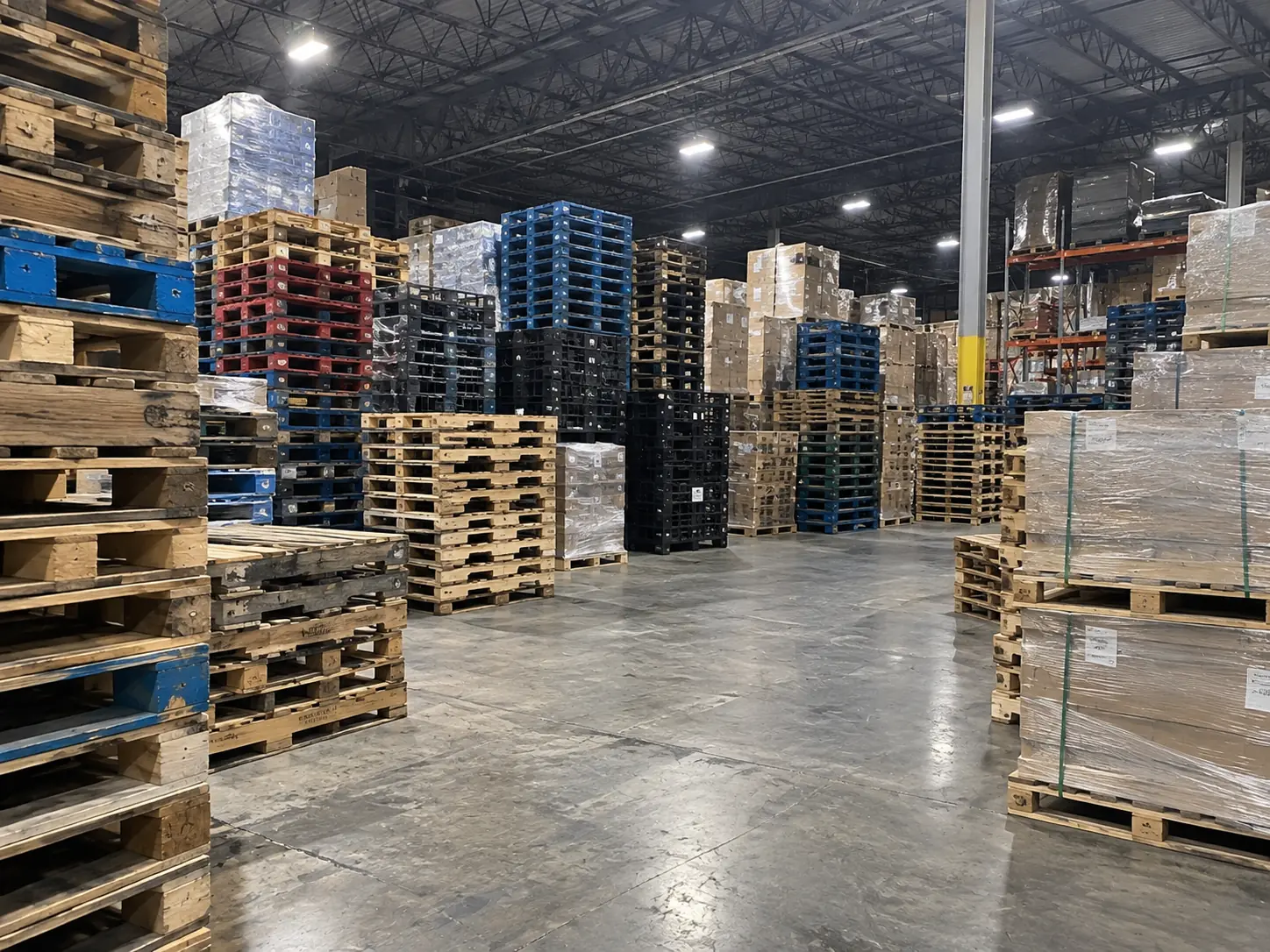
A wide view across the warehouse floor: dozens of stacks of wood and plastic pallets sorted by grade and colour, with wrapped loads and racking behind them.
Sorted by grade and footprint before anything is quoted. Whitewood, plastic and pooled units never share a stack.

Buying pallets

What is the minimum order?
One banded bundle — 12 to 25 pallets depending on grade — for will-call pickup at 10400 Evendale Dr. For delivery the practical minimum is around 100 pallets, because below that freight dominates the unit cost.
How quickly can I get pallets?
Standing recycled inventory ships in 24 to 72 hours. Will-call pickup is same day during business hours. Heat-treated stock adds 5 to 7 days for kiln scheduling. New and custom builds run 10 to 15 business days.
Can I see the pallets before I commit?
Yes. Every quote includes photographs of the actual reserved lot, and you are welcome at the yard during business hours to inspect in person.
Do you sell to individuals, not just businesses?
Yes, for will-call pickup. Small quantities of recycled pallets, reclaimed boards and bulk mulch are all available to walk-in customers.
What payment terms do you offer?
Net 30 on approved commercial accounts. New accounts start on prepayment or credit card until terms are established.
Do prices change through the year?
Yes. Recycled pallet pricing tracks core supply, which is seasonal — cores are scarce in Q4 when retail volume peaks and plentiful in Q1. Annual agreements smooth this out.
Can I get a sample pallet?
For custom builds, yes — prototypes are built in quantities of one to five and billed at cost. For standard recycled grades, photographs of the actual lot serve the same purpose faster.

Selling and recycling your pallets

Do you really pick up for free?
Yes, for loads with recoverable value inside our service radius. If a pile is almost entirely scrap and a long way out, we say so before dispatching rather than surprising you with a charge afterwards.
How many pallets do I need for a pickup?
Around 100 makes a dedicated trip worthwhile. Below that we can often add you to an existing route in your area — ask and we will check the schedule.
Do you pay for pallets?
Yes, per piece on sorted cores or per load on mixed piles. The third option is a credit applied against pallets you buy from us, which is usually the best economics for anyone doing both.
How fast do you pay?
Net 15 from the signed tally sheet by cheque or ACH. Credits against an open order are applied immediately.
Will you take broken pallets?
Yes. Broken pallets are raw material — sound boards get harvested for repairs, the rest is ground. Taking the scrap is how your yard actually ends up clear.
What will you not take?
Pallets that have carried hazardous chemicals, raw meat with an active spill, or wood that is chemically treated or painted with unknown coatings. Send a photo if you are unsure.
Can you take away pallets from a plant closure?
Yes. One-time cleanouts are routine. Send photos and a rough count and we will bring the right number of trailers to clear it in a single visit.
Do you provide recycling documentation?
Monthly, at no charge: tonnage by destination, diversion rate, estimated CO₂e and the methodology behind it. A year-end letter suitable for a corporate responsibility report is available on request.

Specification and grades

What is the difference between A grade and B grade?
A grade has no plugged or companion stringers, all seven top deck boards, and uniform appearance. B grade is structurally sound but shows repair — plugs are permitted, board widths and colours may be mixed.
Are recycled pallets safe for racking?
A and B #1 grades are, within their racked rating. Companion-repaired #2 units should stay out of racking. If in doubt, tell us the rack configuration and we will specify to it.
Are wood pallets food safe?
Wood pallets are not food-contact surfaces under FDA guidance — product should be in sealed packaging or on a slip sheet. We run a dedicated clean-core line with no chemical or agricultural returns for food and beverage customers.
What does the HT stamp mean?
Heat treated to ISPM-15: the wood core reached 56°C for at least 30 continuous minutes. It is a heat process with no chemicals involved.
Is MB-stamped wood dangerous?
MB indicates methyl bromide fumigation. It is phased out in North America. We do not grind MB wood into landscape or animal products and we do not use it in the studio line.
How much weight can a 48x40 hold?
Typically 4,000–6,000 lb static, 2,000–2,800 lb dynamic, 1,500–2,500 lb racked for a sound recycled hardwood unit. Design to the racked number if it goes in a rack.
What species are recycled pallets made from?
Predominantly mixed hardwood — oak, maple, poplar, ash — with softwood present in many lots. Single-species recycled stock does not exist in volume, and any supplier promising it is describing something else.
Can you match a competitor pallet exactly?
Send us one physical unit. We measure it, document the fastener schedule and quote a match. This is faster and far more reliable than working from a drawing.
What moisture content do your pallets ship at?
Below 19% for stock intended for indoor storage or export. Outdoor-staged recycled stock will be higher, and we tell you which you are getting.

Delivery and logistics

What area do you serve?
Roughly 250 miles from Cincinnati on our own equipment: all of Ohio, Kentucky and Indiana, plus parts of Michigan, Tennessee, Pennsylvania and West Virginia. Beyond that we broker through vetted carriers at cost plus a disclosed fee.
How many pallets fit on a truck?
Roughly 550 to 600 empty 48x40s stacked and banded in a 53-ft dry van. Loaded, 26 to 28 floor positions.
Do I need a forklift to receive a delivery?
For dock-height dry van loading, yes, or your team can hand-stack. Our box trucks carry liftgates and our flatbed drivers carry their own equipment on most runs.
Can you leave a trailer at our site?
Yes. Drop trailers are available to accounts running roughly two or more loads per week, with no rental charge on active accounts.
Do you deliver on weekends?
Saturday morning will-call is available at the yard. Weekend delivery is arranged case by case for scheduled projects.
What are your hours?
Monday through Friday 7:00 AM to 5:00 PM Eastern, Saturday 8:00 AM to 12:00 PM, closed Sunday.
How do I reach you — is there a phone number?
We run entirely on email. Write to info@palletsrecycle.com or use any form on this site; both reach the same inbox and both are answered within one business day. We deliberately do not operate a phone line, which is why our written quotes and confirmations are unusually detailed.
How fast do you respond to a quote request?
Within one business day, and usually the same day for requests received before mid-afternoon.

Sustainability and environment

What happens to a pallet you cannot resell?
It goes down the cascade: repair, then board harvest, then remanufacture, then fibre recovery into mulch, bedding or biomass. Under 1% of collected wood reaches landfill.
How much carbon does a recycled pallet save?
A hardwood 48x40 holds roughly 62–80 lb of CO₂ equivalent out of the atmosphere while it exists. The genuine benefit of reuse is retaining that plus avoiding the emissions of a new build — felling, kiln, mill transport and manufacture.
Is your mulch safe for playgrounds?
Our engineered playground fibre is produced from untreated and heat-treated wood only, passes two magnetic separation stages and a screen, and contains no chemically treated material.
Do you recycle the nails?
Yes. Magnetic separation runs on both the dismantling discharge and the grinder outfeed. Recovered steel is baled and sold to regional scrap processors.
Are wood pallets better than plastic environmentally?
On open loops, decisively yes — wood is biogenic, repairable and recyclable through multiple stages. On genuinely closed loops with very high trip counts, plastic can compete. The deciding question is whether the pallet reliably returns.
Can I get diversion reporting for our ESG disclosure?
Yes, monthly and at no charge, with the methodology published openly so your auditor can verify our arithmetic rather than trust it.
Is the wood sourced sustainably?
The overwhelming majority of what we sell was never newly sourced at all — it is recovered. New lumber for builds is bought from regional mills inside a 300-mile radius.

Services and programmes

Do you offer on-site pallet repair?
Yes, for sites generating roughly 1,200 or more damaged pallets a month. We place a crew, benches and board stock inside your building so broken wood never ships anywhere.
What is a pallet management programme?
A single closed loop replacing separate supply, removal, repair and recycling vendors, with core value netted against supply invoices and consolidated reporting across every site you operate.
Can you work alongside CHEP or PECO?
Yes, and many accounts do. Pooled pallets handle lanes that suit pooling; we handle whitewood, odd sizes, one-way export and recovery of everything else.
Do you build custom sizes?
Yes, from 25 units up. Most odd sizes are remanufactured from recovered lumber, which keeps them close to standard pricing rather than new-build pricing.
Do you sell mulch?
Yes — natural, coloured, playground fibre, animal bedding and boiler-grade biomass. Bulk by the cubic yard for pickup, or delivered by walking-floor trailer in larger quantities.
Can you crate machinery at our facility?
Yes, for equipment that cannot be moved. We build around the machine at your location. Mention it when you enquire so a crew can be scheduled.
Do you have a buyback programme for plastic pallets?
Yes. We take end-of-life HDPE and PP pallets regardless of where they were purchased and move them to regional reprocessors for regrind.

Questions nobody asks and probably should

01

What percentage did you reject from my lot?

If the answer is zero from a 580-unit lot, that lot was sorted rather than graded. It is the single most diagnostic question you can ask any pallet supplier, including us.

02

Where do you measure moisture?

The stringer, mid-bundle. A deck board on the outside of a stack reads drier than the stock and tells you nothing useful.

03

Is freight inside the unit price?

It should never be. A combined number hides the only line you can actually change.

04

What do you do with pooled pallets you find in my pile?

Leave them, stacked separately, with a note. Taking them creates a liability on your account that you did not agree to.

05

Has any published constant of yours ever been revised downward?

Two have. It is the test for whether a methodology is real or decorative.

06

What is your rework rate?

We sample finished units from each bench and each shift, pull them apart and record what we find. Ask any repair supplier this and watch what happens.

07

What will you not take?

Pooled units, active chemical spills, unidentified painted coatings without a conversation first. A recycler who takes everything is not segregating.

08

Who answers when something goes wrong?

The same inbox as everything else, within one business day, from a person. There is no ticketing system.