Reusable for years
A hardwood collar with steel hinges survives 50 to 100 cycles. Compared against single-use corrugated gaylords, the payback is usually inside a single quarter.
Accessories are what turn a flat deck into a container. A pallet collar converts a pallet into a stackable crate in eight seconds and folds flat for return. Top caps let you stack unstable loads. Slip sheets eliminate the pallet entirely on container loads. Most operations underuse all three, usually because nobody has shown them the arithmetic.
Send the details and a named person at the Evendale yard replies within one business day with pricing, freight and a piece count — in writing.
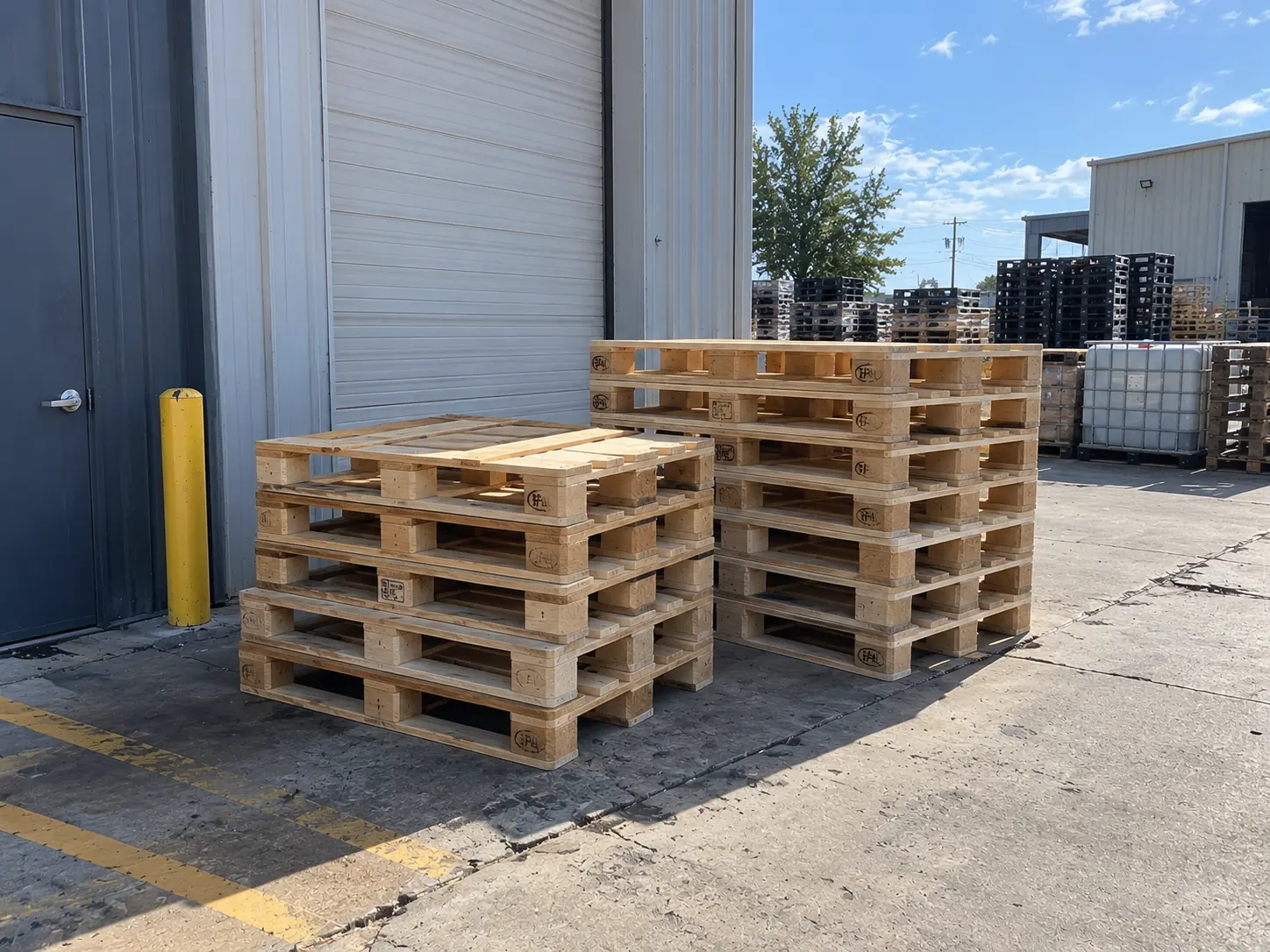
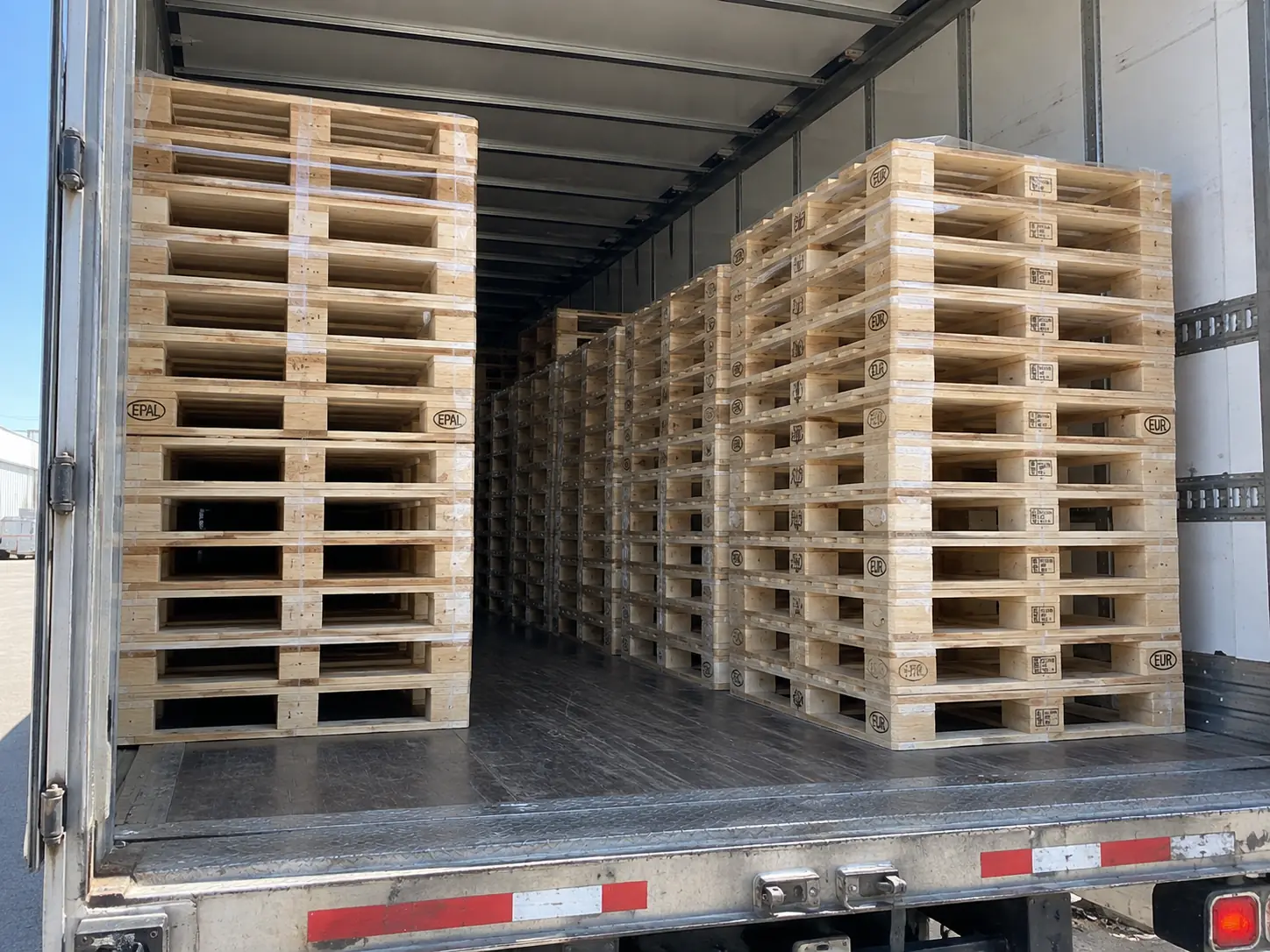
A collar is a hinged wooden frame that sits on a pallet and turns it into an open-topped box. Stack two and you have a deeper box. Stack four and you have a bin. When the load is gone the collar folds to about 2 inches and goes back on the return truck with dozens of others.
A hardwood collar with steel hinges survives 50 to 100 cycles. Compared against single-use corrugated gaylords, the payback is usually inside a single quarter.
Stack collars to match the load instead of shipping air inside a fixed-height box. This alone frequently recovers a container position.
Return volume is roughly one twelfth of assembled volume. Reverse logistics on collars costs almost nothing.
A damaged board is replaced at a bench. A damaged corrugated bin is waste.
| Item | Sizes | Material | Reusable |
|---|---|---|---|
| Hinged pallet collars | 48×40, 1200×800 mm, custom | Hardwood / softwood, steel hinge | Yes — 50–100 cycles |
| Pallet top caps | 48×40 and custom | Plywood, OSB or board | Yes |
| Plastic slip sheets | 48×40 and custom | HDPE, 0.6–0.9 mm | Yes — limited cycles |
| Kraft slip sheets | 48×40 and custom | Laminated kraft | Single trip |
| Layer / separator sheets | Any | Corrugated, plastic, hardboard | Varies |
| Corner board | 36–72 in lengths | Laminated paperboard | Single trip |
| Stretch film | 15–20 in, hand and machine | LLDPE, 60–90 gauge | Single trip |
| Strapping and banding | Poly, cord, steel | Various | Single trip |
A slip sheet is a thin sheet of plastic or laminated kraft with a gripping tab. A push-pull attachment on a forklift grips the tab and drags the load onto a platen. The load never has a pallet under it. On an ocean container that is roughly 5 inches of vertical space and 40 pounds of dead weight recovered per position — which on a regular export lane is a significant number.
Slip sheets only work if the receiving end can handle them. Confirm before you convert a lane — a container of slip-sheeted freight arriving at a dock with no push-pull is a very long day for somebody.
A hinged wooden collar turns a pallet into an open-topped box in about eight seconds, stacks to whatever height the load needs, and folds to roughly two inches for the return trip. Compared against single-use corrugated gaylords the payback is usually inside a quarter, and almost nobody runs the numbers.
| Factor | Hinged wooden collar | Corrugated bulk bin |
|---|---|---|
| Cycles before replacement | 50 – 100 | 1 – 3 |
| Height flexibility | Stack collars to match the load | Fixed — you ship air or you overfill |
| Return volume | ~1/12 of assembled volume, folded flat | Collapses, but bulky and easily damaged |
| Repairability | A damaged board is replaced at a bench | None — it is waste |
| Moisture tolerance | Good | Poor — a wet bin is a failed bin |
| Stacking strength when full | High — the collar carries the load | Moderate, and it degrades with each cycle |
| Disposal at end of life | Enters our wood recovery cascade | Cardboard recycling, if segregated |
The height point is the one that recovers container positions. A fixed-height bin means shipping air whenever the load is shorter than the box; collars let you build to the load. On an export programme that difference frequently pays for the collars on its own.
| Load weight | Material | Thickness | Tab configuration |
|---|---|---|---|
| Up to 1,000 lb, light cases | Laminated kraft | 0.030 in / 0.75 mm | One tab, single trip |
| Up to 2,000 lb, standard | HDPE | 0.024 in / 0.6 mm | One or two tabs |
| 2,000 – 3,500 lb | HDPE | 0.035 in / 0.9 mm | Two tabs, opposite sides |
| Sharp-edged or point loads | HDPE with reinforcement | 0.035 in / 0.9 mm | Two or four tabs |
| Multi-trip closed loop | HDPE, heavier gauge | 0.040 in / 1.0 mm | Four tabs for handling either way |
A container of slip-sheeted freight arriving at a dock with no push-pull is a very long day for somebody, and it happens more often than it should. Confirm the receiving end first, in writing.
| Item | Sizes | Material | Reusable | Typical use |
|---|---|---|---|---|
| Hinged pallet collars | 48×40, 1200×800, custom | Hardwood or softwood, steel hinge | Yes — 50–100 cycles | Turning a pallet into a stackable bin |
| Pallet top caps | 48×40 and custom | Plywood, OSB or board | Yes | Stacking unstable loads; protecting the top layer |
| Plastic slip sheets | 48×40 and custom | HDPE, 0.6–1.0 mm | Limited cycles | Pallet-free container loading |
| Kraft slip sheets | 48×40 and custom | Laminated kraft | Single trip | Lighter one-way loads |
| Layer / separator sheets | Any | Corrugated, plastic, hardboard | Varies | Separating layers in a mixed stack |
| Corner board | 36 – 72 in lengths | Laminated paperboard | Single trip | Protecting edges; raising containment force |
| Stretch film | 15–20 in, hand and machine | LLDPE, 60–90 gauge | Single trip | Unit load containment |
| Poly strapping | 1/2 – 5/8 in | Polypropylene / polyester | Single trip | Banding bundles and securing loads |
| Steel strapping | 1/2 – 3/4 in | Steel | Single trip | Heavy loads, crates, coil |
| Edge protectors | Various | Board or plastic | Varies | Preventing strap cut-in on soft loads |
| Dunnage bags | Various | Kraft / poly | Single trip | Void fill in trailers and containers |
| Pallet runners / bearers | Cut to length | Hardwood | Yes | Raising a pile off the ground — the cheapest core protection there is |