Three stringers
Nominal 1.5 × 3.5 inch members running the 48-inch length. Double-notched on the outer faces to allow four-way fork entry, though partial entry on the 48-inch side is weaker than on the 40-inch side.
The 48x40 GMA stringer pallet is the most-produced pallet footprint in North America, accounting for roughly 30% of all new wood pallets built each year. It exists because it is exactly half the width of a standard 96-inch trailer and fits two-across with no wasted space. We hold it in every grade, all year, in quantity.
Send the details and a named person at the Evendale yard replies within one business day with pricing, freight and a piece count — in writing.
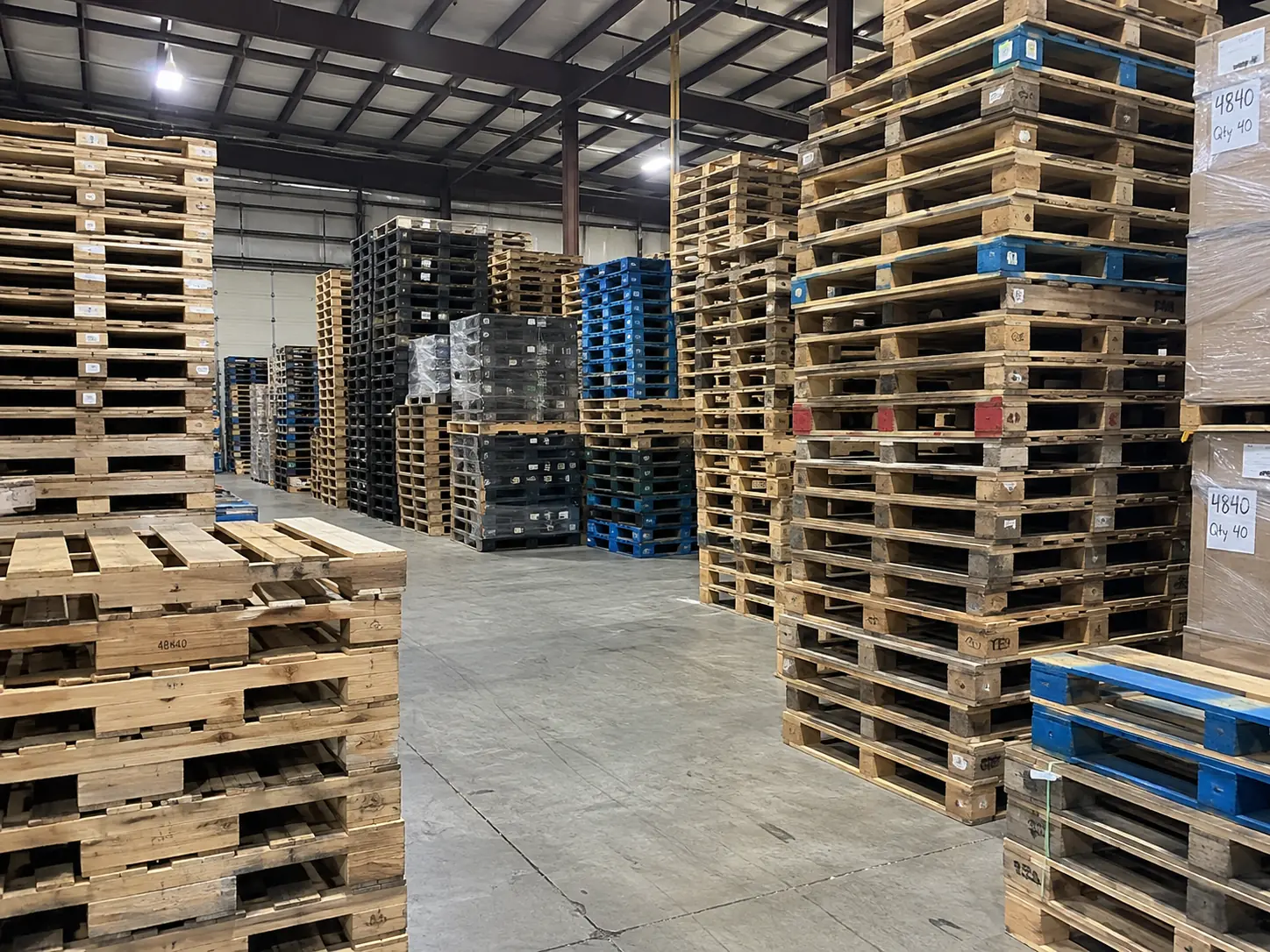
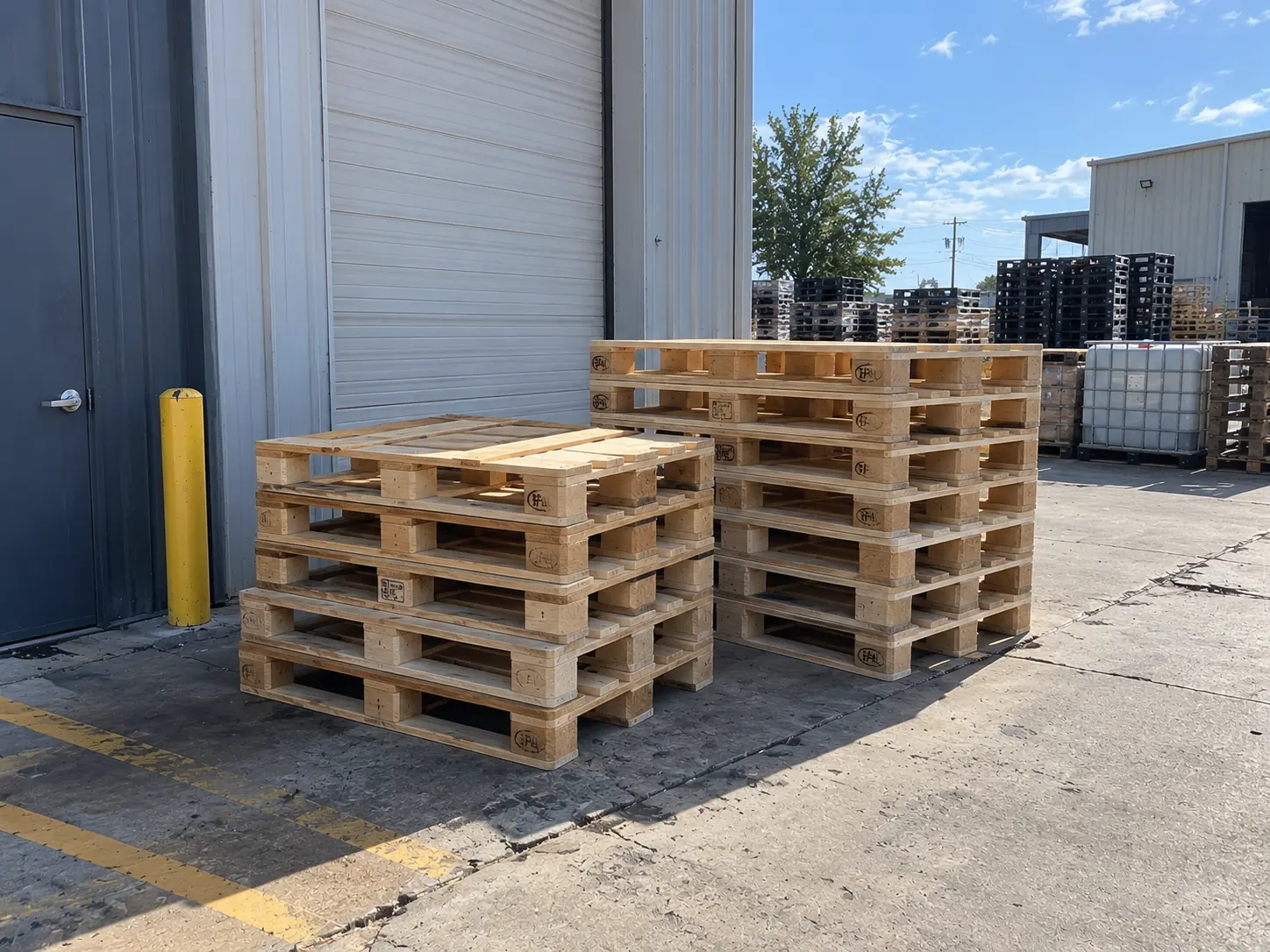
The dimension is not arbitrary and it is not American exceptionalism. A standard North American trailer has an interior width of roughly 98 to 100 inches. Two 48-inch pallets sit side by side at 96 inches with clearance for loading. Twenty-eight of them fill a 53-ft floor. The 40-inch depth then matches the standard grocery store aisle module and the standard retail display footprint. Every other common North American size is a deviation from this one for a specific reason.
Nominal 1.5 × 3.5 inch members running the 48-inch length. Double-notched on the outer faces to allow four-way fork entry, though partial entry on the 48-inch side is weaker than on the 40-inch side.
Lead boards at each end are wider (5.5 in) because they take the impact of fork entry. Interior boards are typically 3.5 in with gaps up to 3.5 in.
Three of these sit under the lead and centre positions. The bottom deck is what makes the pallet rackable and what distributes load on a conveyor.
The leading edges of the bottom deck are bevelled so a pallet jack rolls up rather than catching. A detail that is missing on cheap builds and immediately noticeable on a busy dock.
| Offering | Grade | Lead time | Notes |
|---|---|---|---|
| Recycled A / #1 | Premium | 24–72 hours | No companions, no plugs, uniform appearance |
| Recycled B / #1 | Standard | 24–72 hours | Plugs permitted, racking approved |
| Recycled B / #2 | Economy | 24–72 hours | Companion stringers permitted, floor use |
| Recycled, heat-treated | A or B | 5–7 business days | Re-treated and stamped under our program |
| New hardwood build | New | 10–15 business days | Built to GMA spec on a fixed jig |
| New softwood build | New | 10–15 business days | Lighter, lower cost, export friendly |
Every dimension on a GMA 48×40 that anybody has ever asked us for, in both units. Where a range is given it is because recycled stock genuinely varies within it and pretending otherwise is not useful.
| Dimension | Imperial | Metric |
|---|---|---|
| Length, stringer axis | 48.0 in | 1219 mm |
| Width, deck board axis | 40.0 in | 1016 mm |
| Overall height | 5.5 – 6.5 in | 140 – 165 mm |
| Stringer section, nominal | 1.5 × 3.5 in | 38 × 89 mm |
| Stringer count | 3 (4 on heavy-duty builds) | — |
| Notch width | 9.0 in | 229 mm |
| Notch depth | 1.5 in | 38 mm |
| Notches per outer stringer | 2 | — |
| Top deck boards | 7 | — |
| Lead board width | 5.5 in | 140 mm |
| Interior board width | 3.5 in | 89 mm |
| Deck board thickness | 0.5 – 0.75 in | 13 – 19 mm |
| Maximum deck gap | 3.5 in | 89 mm |
| Bottom deck boards | 5 | — |
| Fork entry height | 3.5 in minimum | 89 mm |
| Fork opening width, 40-in side | ~35 in clear | ~889 mm |
| Chamfer on bottom boards | ~0.25 in bevel | ~6 mm |
| Empty weight | 33 – 48 lb | 15 – 22 kg |
| Wood volume, approximate | 0.85 – 1.05 ft³ | 0.024 – 0.030 m³ |
| Fastener count | 70 – 100 | — |
| Steel content | ~2.0 lb | ~0.9 kg |
| Deck surface area | 13.33 ft² | 1.24 m² |
| Equipment | Floor positions | Double stacked | Empty stacked and banded |
|---|---|---|---|
| 53-ft dry van | 26 – 28 | 52 – 56 | ~560 |
| 48-ft dry van | 24 | 48 | ~500 |
| 26-ft box truck | 12 | 24 | ~140 |
| 40-ft ocean container | 20 – 21 | 40 – 42 | ~440 |
| 40-ft high cube container | 20 – 21 | 40 – 42 (more headroom) | ~470 |
| 45-ft high cube container | 24 – 25 | 48 – 50 | ~500 |
| 20-ft ocean container | 10 – 11 | 20 – 22 | ~220 |
| Standard selective rack bay, 96-in beam | 2 across | — | — |
| Standard selective rack bay, 144-in beam | 3 across | — | — |
The rack rows are the ones worth checking against your own building. A 96-inch beam opening takes two 48×40 pallets across with essentially no clearance, which is fine until a load overhangs by an inch. If your loads run to the deck edge, a 108-inch beam is a far more forgiving standard and it costs very little more at the point of installation.
Because we handle around 900,000 of these a year, the failure distribution is unusually clear. These are the six that account for almost everything.
By far the most common. The notch removes 1.5 in of depth at the point of highest bending stress. If a unit is cracked, look here first — you will almost always be right.
Lead boards absorb every fork entry. They are wider than interior boards for exactly this reason, and they still go first. Two-to-one over interior board failures in our intake.
Pallet jack damage on a non-chamfered or worn chamfer. Invisible from above, which is why a grader turns every unit once.
Somebody hammered a proud nail flat instead of replacing it. The wood beneath compresses and it works proud again within a week.
Small cartons or a drum chime resting across a 3.5-in gap. A specification problem rather than a pallet problem — tight-laid deck solves it.
The dangerous one. Stringers should run across the beams, front to back. Loaded the other way, a unit rated 2,000 lb racked is doing considerably less.