Wood Pallet Recycling Guide
In short
Wood pallet recycling is the largest and least-discussed recycling success story in industrial packaging. Roughly 95% of wood pallets that reach a recycler in North America avoid landfill, and the majority go back into service as pallets rather than being ground. This guide explains the cascade, the carbon accounting behind it, and how to set up a programme that is genuinely zero-landfill rather than nominally so.
Quote: Wood Pallet Recycling Guide
Send the details and a named person at the Evendale yard replies within one business day with pricing, freight and a piece count — in writing.
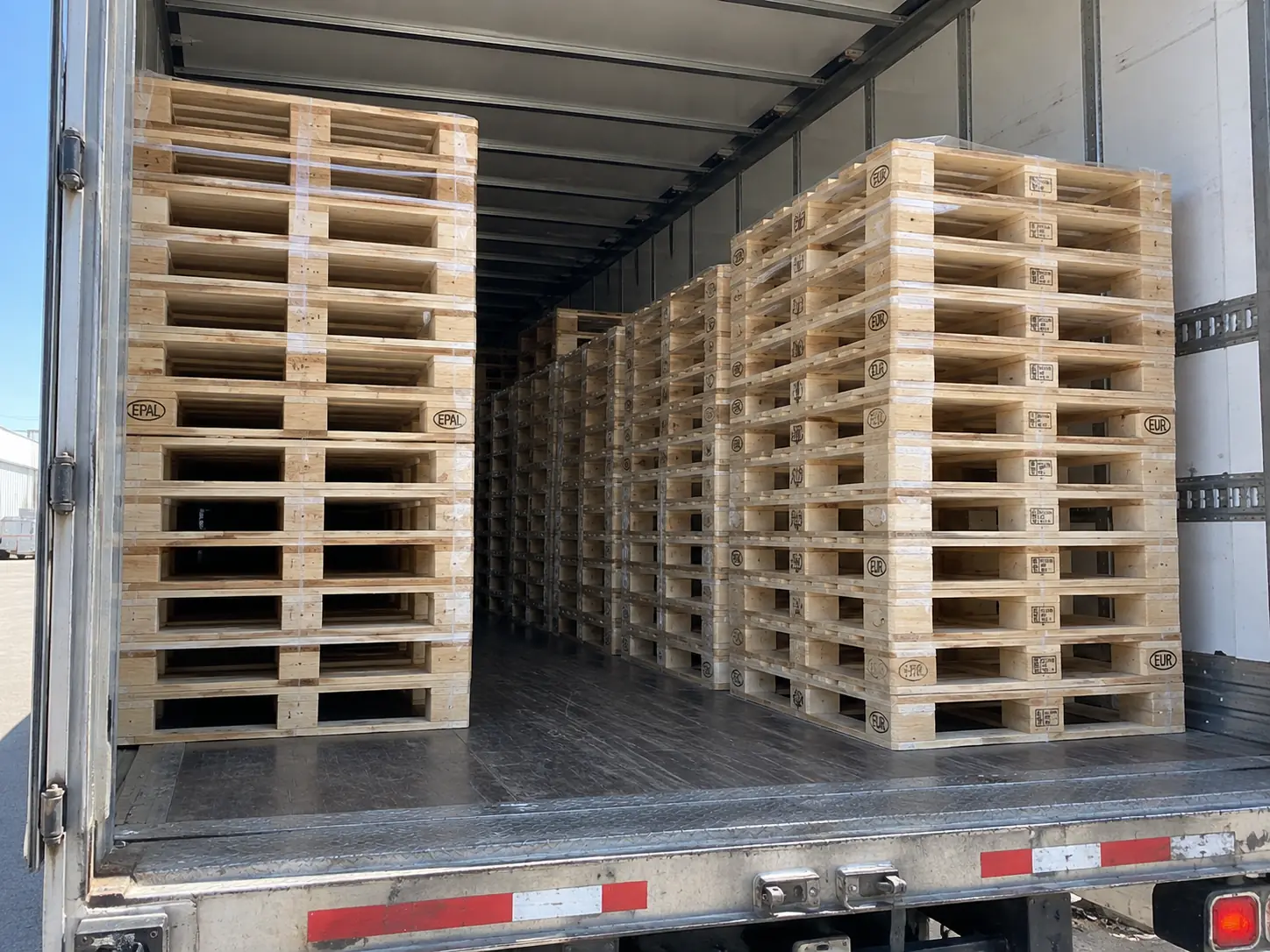
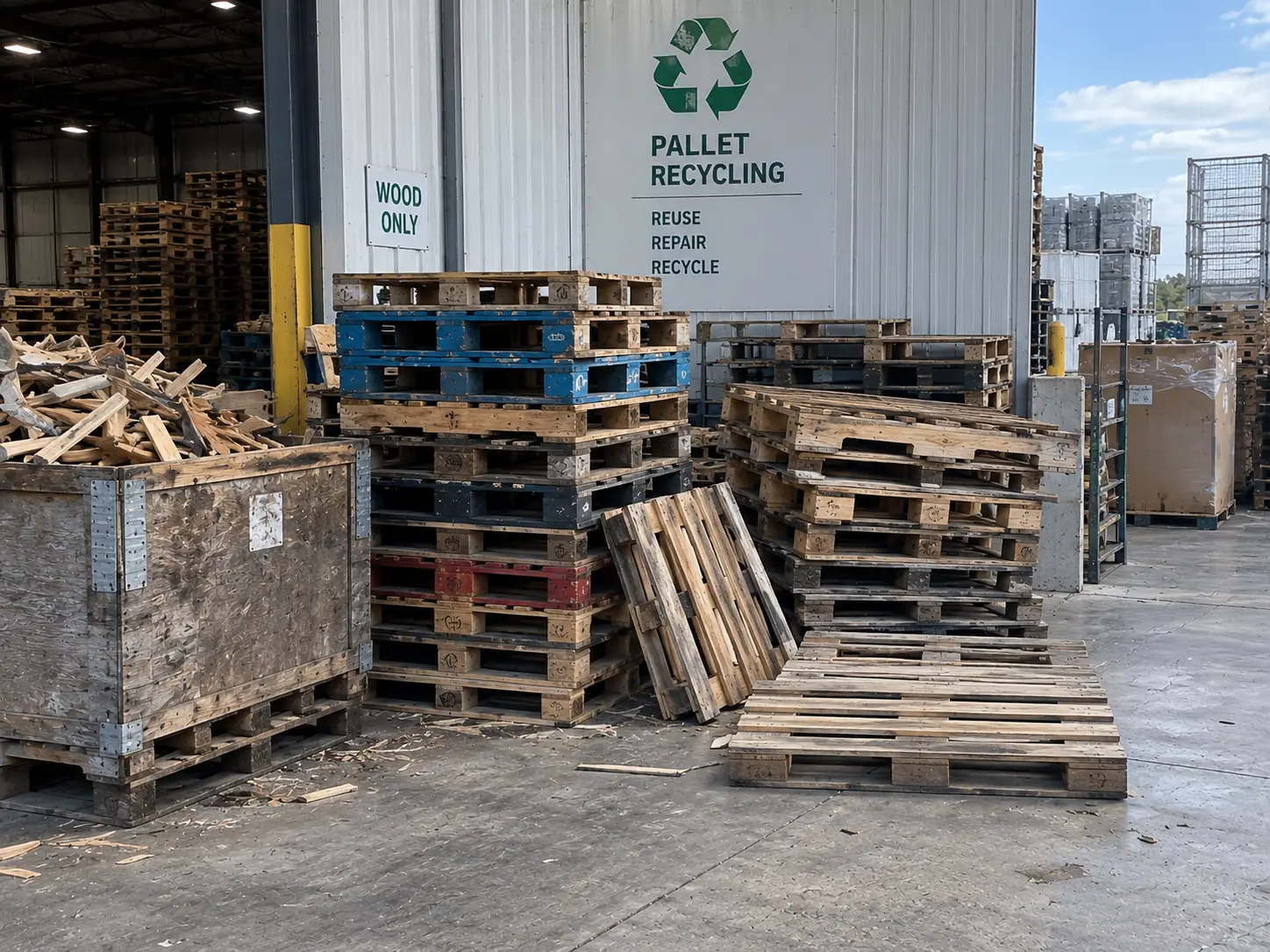
The cascade, and why order matters
Every recycling conversation eventually reaches the same mistake: treating "recycled" as a single binary outcome. It is not. There is an ordered hierarchy of outcomes, each dramatically better than the one below it, and the entire environmental case for pallet recycling depends on staying as high up that hierarchy as possible for as long as possible.
- Reuse — best outcome
Inspect, clean, grade, re-ship. Almost no energy input. The board keeps doing exactly what it was milled to do. Roughly 55% of intake.
- Repair — very good
Replace what failed, keep the other 95% of the structure. Energy input is a nail gun and two minutes of labour. About 27%.
- Board harvest — good
The frame is gone but the lumber is not. Sound boards become repair stock for other pallets. Around 9%.
- Remanufacture — good
Rebuild recovered components into a smaller or different footprint on a jig. About 5%.
- Fibre recovery — acceptable
Grind into mulch, bedding or biomass fuel. The carbon is still stored for a while in mulch and released quickly in fuel. The final 3%.
- Landfill — failure
Buried wood decomposes anaerobically and produces methane, a far more potent greenhouse gas than the CO₂ it would have released by burning. Under 1%, and reported.
The carbon accounting, honestly
Wood pallets are made of carbon that a tree pulled out of the atmosphere. While the pallet exists, that carbon stays out of the atmosphere. This is the entire basis of the sustainability claim, and it is real — but it is frequently overstated by suppliers who count the same tonne of carbon several times.
- A 48 × 40 hardwood pallet contains roughly 35–45 lb of wood, which is roughly 17–22 lb of carbon, equivalent to roughly 62–80 lb of CO₂ held out of the atmosphere.
- That carbon is not additional each time the pallet is reused — it is the same carbon, retained longer. Retention is the benefit, not multiplication.
- The genuinely additional benefit of reuse is avoided emissions: no new tree felled, no kiln run, no mill transport, no new manufacture.
- Transport is the dominant emissions cost in a recycled pallet's life. A pallet trucked 400 miles can undo much of the benefit of recycling it.
- This is why local recovery matters more than any other single factor, and why we are transparent that our radius is about 250 miles rather than claiming national coverage.
Running a genuinely zero-landfill programme
- Stop paying to dispose of an asset. Audit your waste invoices for wood tonnage — a surprising number of sites are paying both to buy and to discard.
- Separate at the point of generation. A pallet pile that is only pallets has value; one with shrink wrap, banding and broken product mixed in costs money to sort.
- Do not sort by "good" and "broken" unless your recycler asks you to. Most, including us, would rather sort properly at the yard than have a receiver guess.
- Set a collection cadence that matches generation. Piles that outgrow their space become safety and fire issues long before they become a cost issue.
- Keep the pile dry and under cover if at all possible. Wet wood loses value fast and mould-bloomed wood loses it entirely.
- Demand reporting. Tonnage in, tonnage by destination, diversion rate. If your recycler cannot produce it, they are not measuring it.
- Close the loop where you can. Buying recycled pallets from the same partner who collects your cores is the single highest-leverage thing most operations can do.
Twelve months of recovery, by weight
Weight, not piece count. Piece counts flatter, because the material most likely to end up in the disposal stream is also the wettest and heaviest. Everything below comes from weighbridge tickets in and out, reconciled monthly.
| Stream | Share by weight | Tons | Destination |
|---|---|---|---|
| Direct reuse | 55.3% | 27,240 | Back out as a graded pallet, no tool used |
| Repair and return | 27.0% | 13,300 | Bench repair, regraded, banded |
| Board harvest | 9.1% | 4,483 | De-nailed lumber into our own repair stock |
| Remanufacture | 5.2% | 2,562 | Jig-built into 42×42, 36×36, 48×45 and custom |
| Fibre recovery | 2.9% | 1,429 | Mulch, playground fibre, animal bedding, hog fuel |
| Licensed disposal | 0.5% | 246 | Chemically treated, MB-stamped, non-wood debris |
| Ferrous recovery (separate stream) | — | 1,186 | Baled nails and banding to regional scrap processors |
The seasonal signal in the record
Direct reuse ranges from 51.4% in April to 59.1% in July. It would be easy to read that as grader drift, and we checked for exactly that. It is moisture: cores collected in March and April have spent weeks in Ohio rain, and wet wood grades worse on appearance, carries more mould risk and is structurally weaker while wet.
| Month | Intake | Mean moisture | Direct reuse | To fibre |
|---|---|---|---|---|
| January 2026 | 138,600 | 17.8% | 55.1% | 3.2% |
| February 2026 | 131,200 | 18.4% | 54.3% | 3.3% |
| March 2026 | 126,500 | 20.6% | 52.6% | 3.6% |
| April 2026 | 122,800 | 22.1% | 51.4% | 3.9% |
| May 2026 | 117,300 | 18.0% | 54.7% | 3.2% |
| June 2026 | 112,600 | 14.2% | 57.9% | 2.8% |
| July 2026 | 104,900 | 12.4% | 59.1% | 2.6% |
| August 2026 | 108,200 | 12.9% | 58.3% | 2.7% |
That single finding is why we now raise covered storage with every customer who sells cores regularly, and why the drop-trailer arrangement gets recommended as much for stock protection as for dock convenience. Data turned a soft recommendation into a specific one.
Auditing a recycler in seven questions
- Is this measured by weight or by piece count? Piece counts systematically understate the disposal fraction.
- What are all the outbound streams, by weight — including licensed disposal? The missing one is almost always the last one.
- What is the boundary: wood only, or everything that arrived on the trailer?
- Is reuse separated from grinding? Both count as diverted and they are nothing like equivalent.
- Can I see the underlying weighbridge tickets, not just the summary?
- How is contaminated material handled, and is that tonnage named or absorbed into a rounding?
- Has the methodology changed? A rate that improves with no operational change usually means the method did.