Open slat crate
Spaced boards over a frame. Light, cheap, lets the contents breathe and be inspected. Right for machinery parts, castings and anything that does not need weather protection.
When a load is heavy, fragile, oddly shaped or crossing an ocean, a crate is the right container. We build export crates, reusable returnable containers and skid-mounted boxes to your dimensions, in plywood, solid board or a hybrid, with ISPM-15 treatment where the destination requires it.
Send the details and a named person at the Evendale yard replies within one business day with pricing, freight and a piece count — in writing.
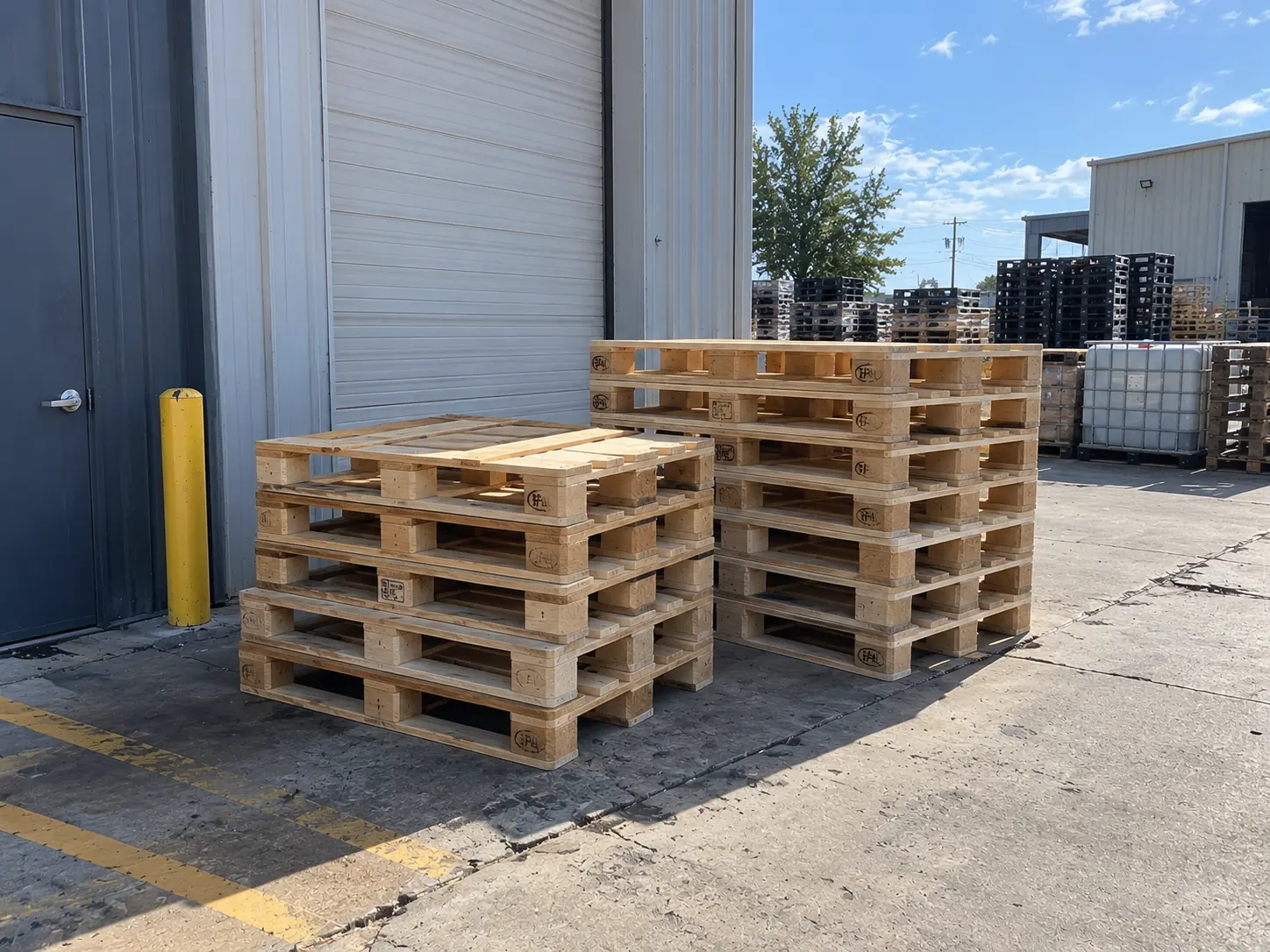
Spaced boards over a frame. Light, cheap, lets the contents breathe and be inspected. Right for machinery parts, castings and anything that does not need weather protection.
Full sheathing over a frame. Weather resistant, tamper evident, takes stencilling well. The default for export of finished goods.
A box built onto an integral heavy skid base. Handles as one unit with a forklift, rated for point loads that would destroy a standard pallet.
Bolted or clipped panels that disassemble flat for return. Economic on closed-loop lanes where the container returns more than about six times.
Plywood panels with solid cleat framing. The standard for military and aerospace shipping specifications.
Standard pallet, stacked collars and a top cap. The cheapest and fastest "crate" there is, assembled in under a minute from stock parts.
A reusable knock-down crate costs roughly 1.6 to 2.2 times a one-way equivalent. It pays back once it completes about four to six round trips, assuming return freight is consolidated with an existing lane. If your return leg is empty anyway — and for most manufacturers it is — the payback arrives faster and the environmental case is overwhelming.
| Trips | One-way total cost | Reusable total cost | Verdict |
|---|---|---|---|
| 1–3 | Lower | Higher | One-way wins |
| 4–6 | Comparable | Comparable | Break-even; choose on handling and damage |
| 7–15 | Higher | Lower | Reusable wins clearly |
| 15+ | Much higher | Much lower | Reusable, with a scheduled repair budget |
Machinery does not distribute its weight. It sits on feet, a frame or a casting and concentrates load onto small areas. A base designed for the overall footprint rather than the actual contact points will have runners in the wrong places, and the deck fails at the first rough handling.
A sealed container crossing an ocean goes through repeated temperature cycles, and every cycle condenses moisture on the coldest surface inside. On a machined steel surface that is corrosion, and it arrives looking like a manufacturing defect.
| Control | What it does | When to specify it |
|---|---|---|
| Dry crate timber, below 15% MC | Removes a moisture source sealed inside the box for six weeks | Always |
| Vapour barrier bag | Isolates the machine from container air | Any machined or unpainted steel surface |
| Desiccant, sized to volume and duration | Absorbs what gets in; the calculation is standard and routinely skipped | Ocean transit over about two weeks |
| Volatile corrosion inhibitor | Vapour-phase protection on machined surfaces | Precision surfaces, bearings, unpainted tooling |
| Humidity indicator card | Lets the receiver see whether the protection held | Any lane where you have had a corrosion claim |
| Ventilation instead of sealing | Opposite strategy — appropriate for some cargoes | Only where the commodity tolerates ambient humidity |
A reusable knock-down crate costs roughly 1.6 to 2.2 times a one-way equivalent. It pays back at around four to six round trips, assuming return freight is consolidated onto an existing lane. If your return leg runs empty anyway — and for most manufacturers it does — the payback arrives sooner and the environmental case is overwhelming.
| Round trips | One-way total cost | Reusable total cost | Verdict |
|---|---|---|---|
| 1 – 3 | Lower | Higher | One-way wins |
| 4 – 6 | Comparable | Comparable | Break-even; choose on handling and damage rates |
| 7 – 15 | Higher | Lower | Reusable wins clearly |
| 15 – 30 | Much higher | Much lower | Reusable, with a scheduled repair budget |
| 30+ | Not a serious option | Lowest by a wide margin | Reusable, and design for repair from the start |
The variable that most often breaks the model is return discipline. A reusable crate programme with no owner degrades into a one-way programme at reusable prices within about two quarters, which is the worst of both. If nobody will own the return leg, buy one-way and be honest about it.