Heat-Treated ISPM-15 Pallets
In short
Any solid wood packaging crossing an international border must be treated and marked under ISPM-15. Heat treatment raises the wood core to 56°C for a minimum of 30 continuous minutes, killing pests without chemicals. We supply both new and recycled pallets treated and stamped to that standard, with treatment records retained for your customs file.
Quote: Heat-Treated ISPM-15 Pallets
Send the details and a named person at the Evendale yard replies within one business day with pricing, freight and a piece count — in writing.
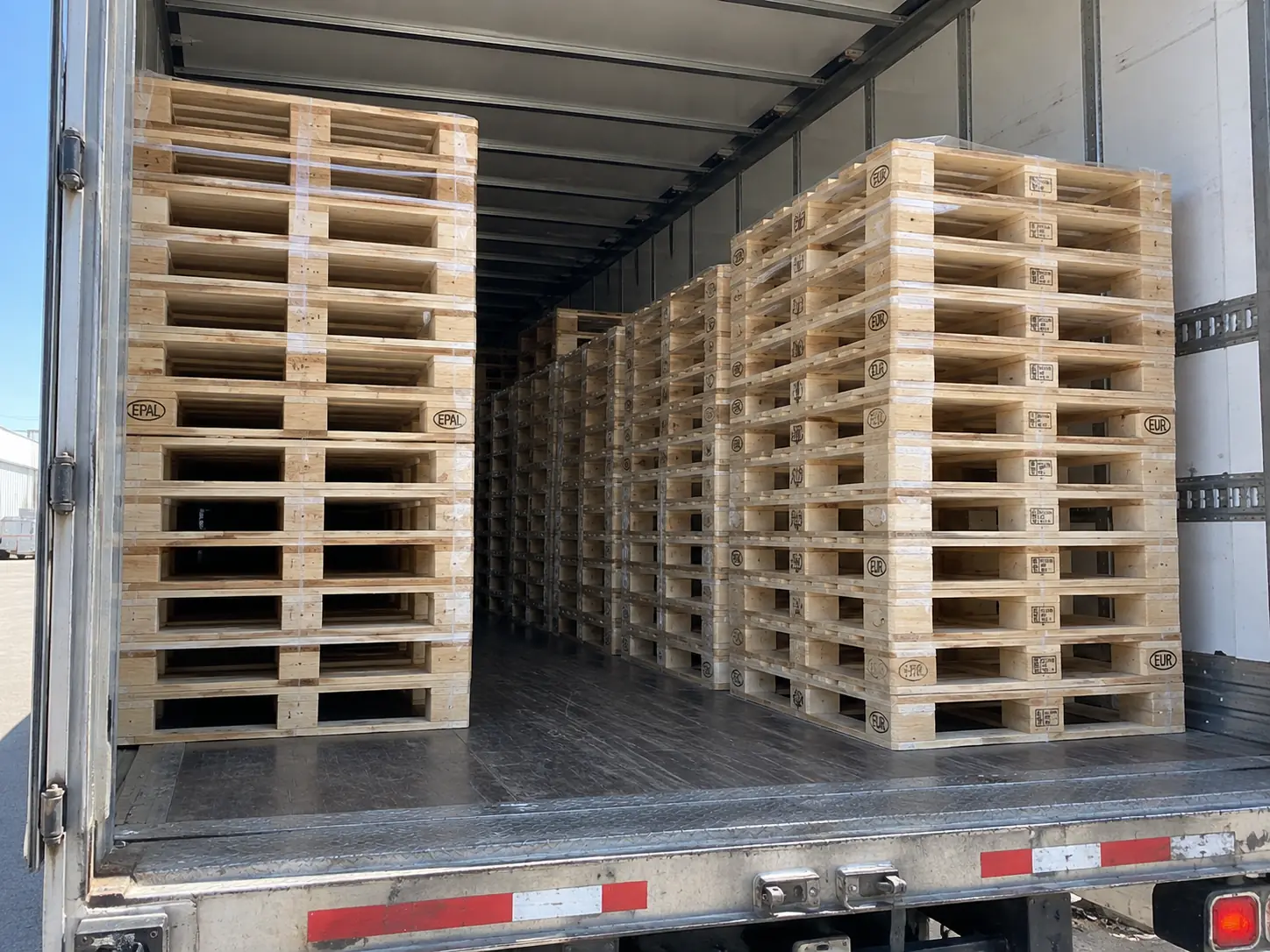
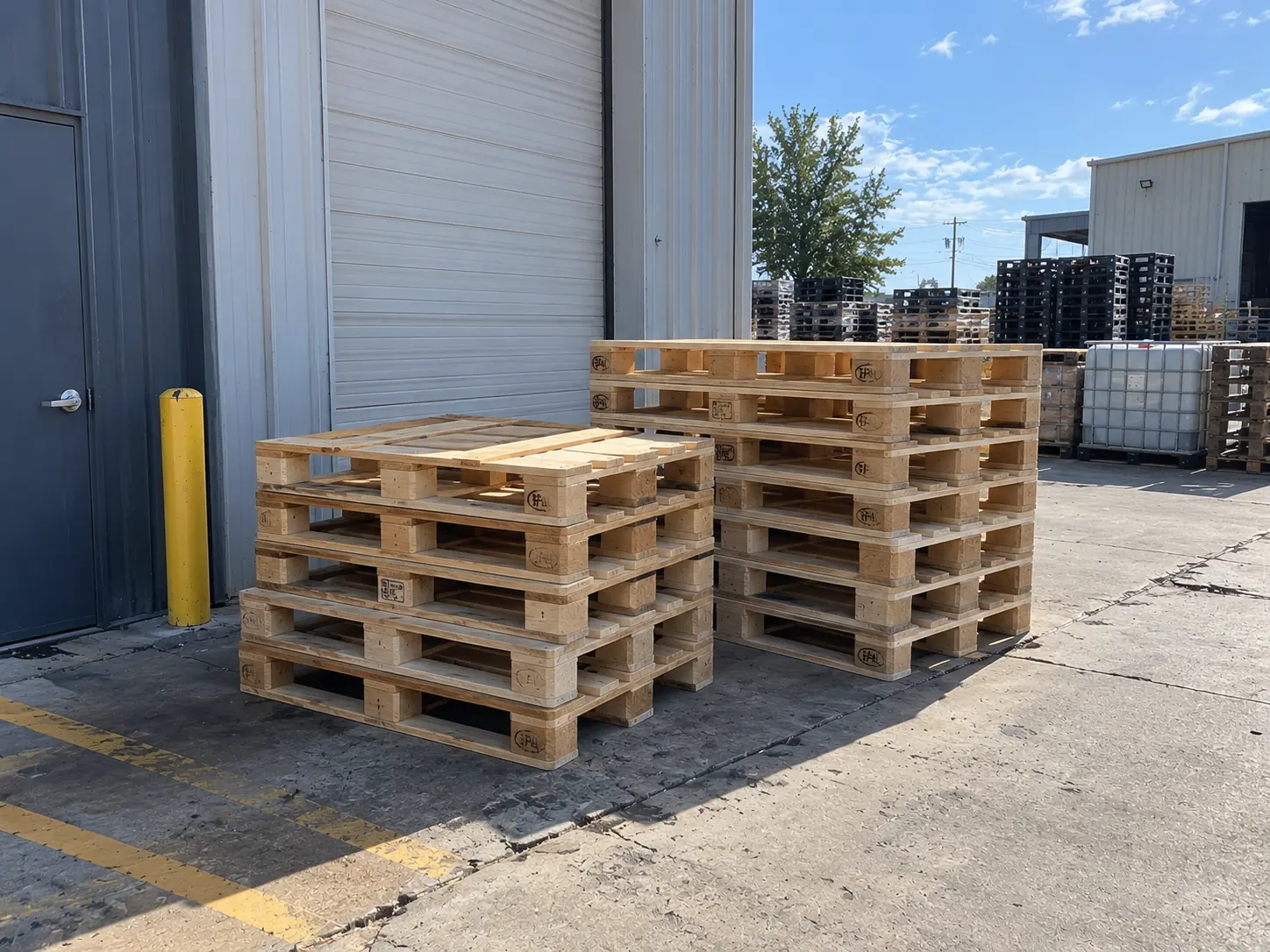
What the regulation actually requires
ISPM-15 is an International Plant Protection Convention standard adopted by more than 180 countries. It applies to solid wood packaging material thicker than 6 mm — pallets, crates, dunnage, drums, blocking and bracing. It does not apply to plywood, oriented strand board, particleboard, or wood that has been processed enough to eliminate pest risk.
- Heat treatment (HT): wood core reaches 56°C for a minimum of 30 continuous minutes
- Dielectric heating (DH): an alternative method reaching 60°C through the full profile for 1 minute
- Methyl bromide (MB): a chemical fumigation route now phased out in North America and banned outright by a growing list of importing countries
- Marking: the IPPC wheat symbol, ISO country code, unique facility number and treatment code, applied to at least two opposite sides
How treatment works here
- Inspection and moisture check
Only sound, dry, bark-free wood enters the chamber. Bark is a pest harbour and is a compliance failure in its own right.
- Chamber loading
Units are stacked with spacing that lets heated air reach every face. Overloading a chamber is the most common cause of an under-treated core.
- Probe placement
Temperature probes are set in the thickest members of the load, not in the air. The standard is about wood core temperature, not chamber temperature.
- Treatment cycle
The chamber holds until every probe reads 56°C or higher for 30 continuous minutes. The cycle is logged automatically.
- Marking and record
Units are stamped on two opposite sides with the IPPC mark and the treatment record is filed against your order number.
Reading an ISPM-15 stamp
| Element | Example | Meaning |
|---|---|---|
| IPPC symbol | Wheat sheaf logo | Certifies the mark is issued under the international standard |
| Country code | US | ISO two-letter code of the treating country |
| Facility code | 45241-OH | Unique identifier of the accredited treatment facility |
| Treatment code | HT | HT = heat treated, DH = dielectric, MB = methyl bromide |
| Optional | DB | Debarked — required by some destinations |
An old HT stamp on a used pallet does not certify the pallet today. Treatment is a point-in-time event and the wood can be re-infested afterwards. For export, always source freshly treated stock or have existing stock re-treated.
Observed kiln cycle times, by species and section
ISPM-15 requires a 56°C wood core held for 30 continuous minutes. How long the chamber takes to get there depends on species, thickness, starting moisture and how tightly the load is stacked. These are our own observed cycle times, published because "five to seven days" is a scheduling answer and this is the reason behind it.
| Species | Section | Starting MC | Typical cycle | Note |
|---|---|---|---|---|
| Yellow poplar | 1.5 in stringer | 14% | 4.5 – 5.5 hrs | Fastest common stringer stock we treat. |
| Southern yellow pine | 1.5 in stringer | 15% | 5.0 – 6.5 hrs | Resin can extend hold time in a heavily loaded chamber. |
| Red oak | 1.5 in stringer | 16% | 6.5 – 8.5 hrs | Dense and slow. The species that sets our scheduling. |
| Hard maple | 1.5 in stringer | 15% | 7.0 – 9.0 hrs | Longest routine cycle on our board. |
| Mixed hardwood | 3.5 in block | 17% | 8.5 – 10.5 hrs | Block pallets are probed in the block, never in the deck. |
| Any species | Above 19% MC | 20%+ | +2.0 – 3.5 hrs | Wet stock costs kiln hours. This is one reason we ship dry. |
What is on a chamber log, and what to ask for
If a customs enquiry lands, this is the document that answers it. Published so you know what to request — from us or from anybody treating wood on your behalf.
| Field | Why it matters |
|---|---|
| Facility identifier | The accredited number that appears in your stamp. Without it the mark means nothing. |
| Cycle reference and date | Ties a specific load to a specific run. |
| Order reference | So the log can be found against your purchase order, not just by date. |
| Probe positions | Which members, and where in the load. Probes in the air invalidate the run. |
| Probe temperature trace | Continuous, automatically logged. Every probe, for the whole cycle. |
| Hold period achieved | The 30 continuous minutes at or above 56°C, on the lowest-reading probe. |
| Load description and piece count | What was actually in the chamber. |
| Operator | Somebody to ask. |
| Marking record | When and where the IPPC mark was applied, and to how many units. |
We retain these against your order and supply them on request within the hour. If a supplier cannot produce a probe trace for a specific cycle, they are describing a process rather than evidencing one.
Destination requirements at a glance
| Destination | ISPM-15 required | Notes |
|---|---|---|
| European Union | Yes | Strictly enforced. Bark-free requirement applied rigorously. |
| United Kingdom | Yes | Required since 2021. |
| China | Yes | Enforced. Additional fumigation certificates sometimes requested. |
| Japan, South Korea | Yes | Enforced. |
| Australia, New Zealand | Yes | Among the strictest inspection regimes globally. |
| Brazil | Yes | Enforced. |
| India | Yes | Enforced. |
| Canada | Generally exempt from the US | Bilateral exemption for wood of US or Canadian origin. |
| Mexico | Generally exempt from the US | Verify per commodity and per port of entry. |
- Plywood, OSB and particleboard are exempt — manufacturing already eliminates pest risk. A plywood-sheathed cleated crate is genuinely simpler to clear.
- Plastic pallets are exempt entirely. On a frequent export lane that exemption is worth real money.
- Dunnage, blocking, bracing and chocks are in scope and are the most commonly missed items in the container.
- ISPM-15 has no expiry date, but an inspector assesses the wood in front of them. Mould, damp, bark or live pests fail a shipment regardless of the stamp.