Already dried
New pallets are frequently built from green lumber at 25–30% moisture. They shrink, boards loosen and nails back out in the first month. A recycled pallet has completed that movement.
A recycled pallet is a used pallet that has been inspected, repaired where necessary and returned to a defined grade. It costs meaningfully less than new, performs identically for the vast majority of applications, and carries roughly a tenth of the embodied carbon. This is the core of what we sell, and it is what leaves our Evendale yard on most trailers.
Send the details and a named person at the Evendale yard replies within one business day with pricing, freight and a piece count — in writing.
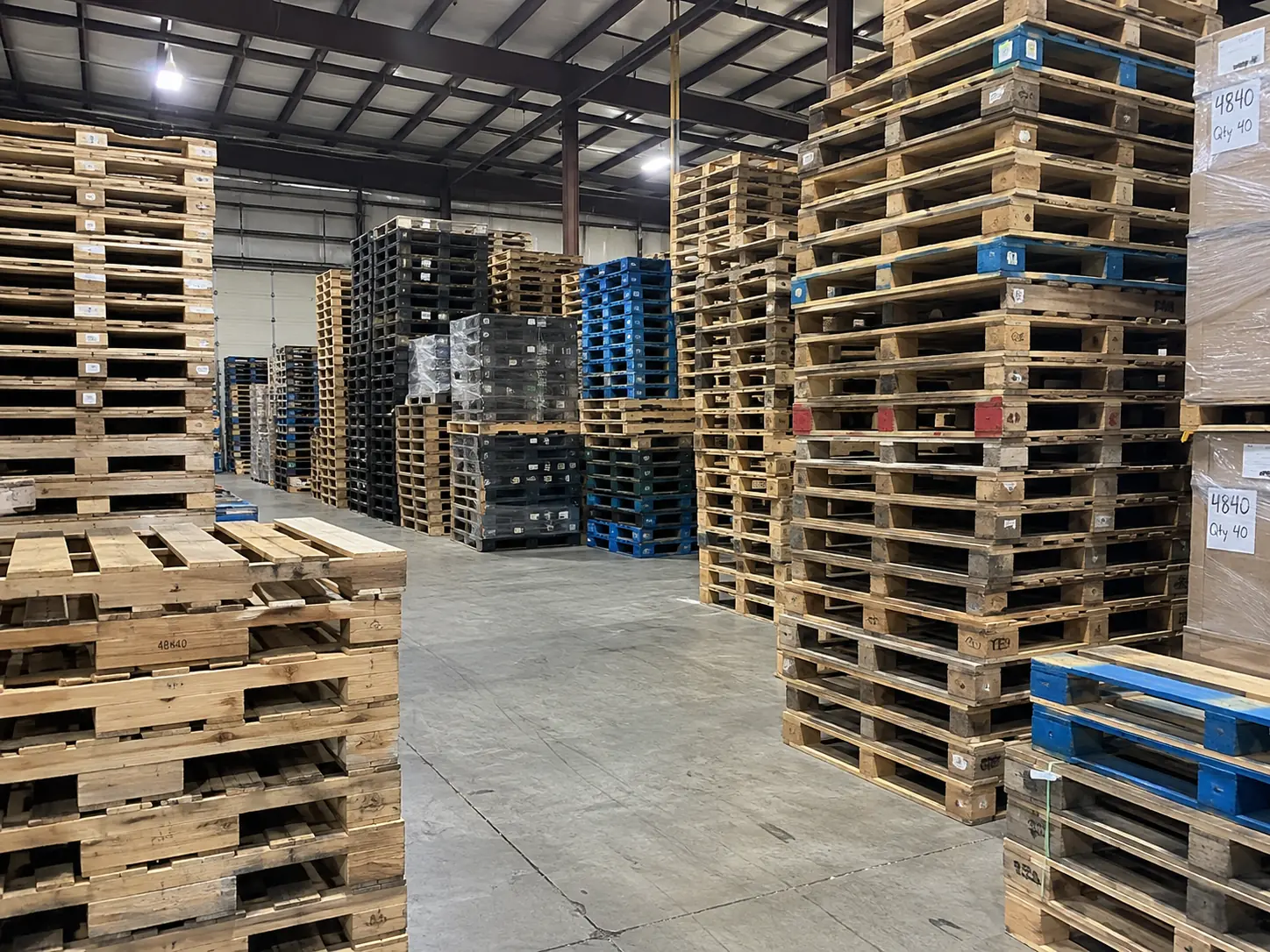
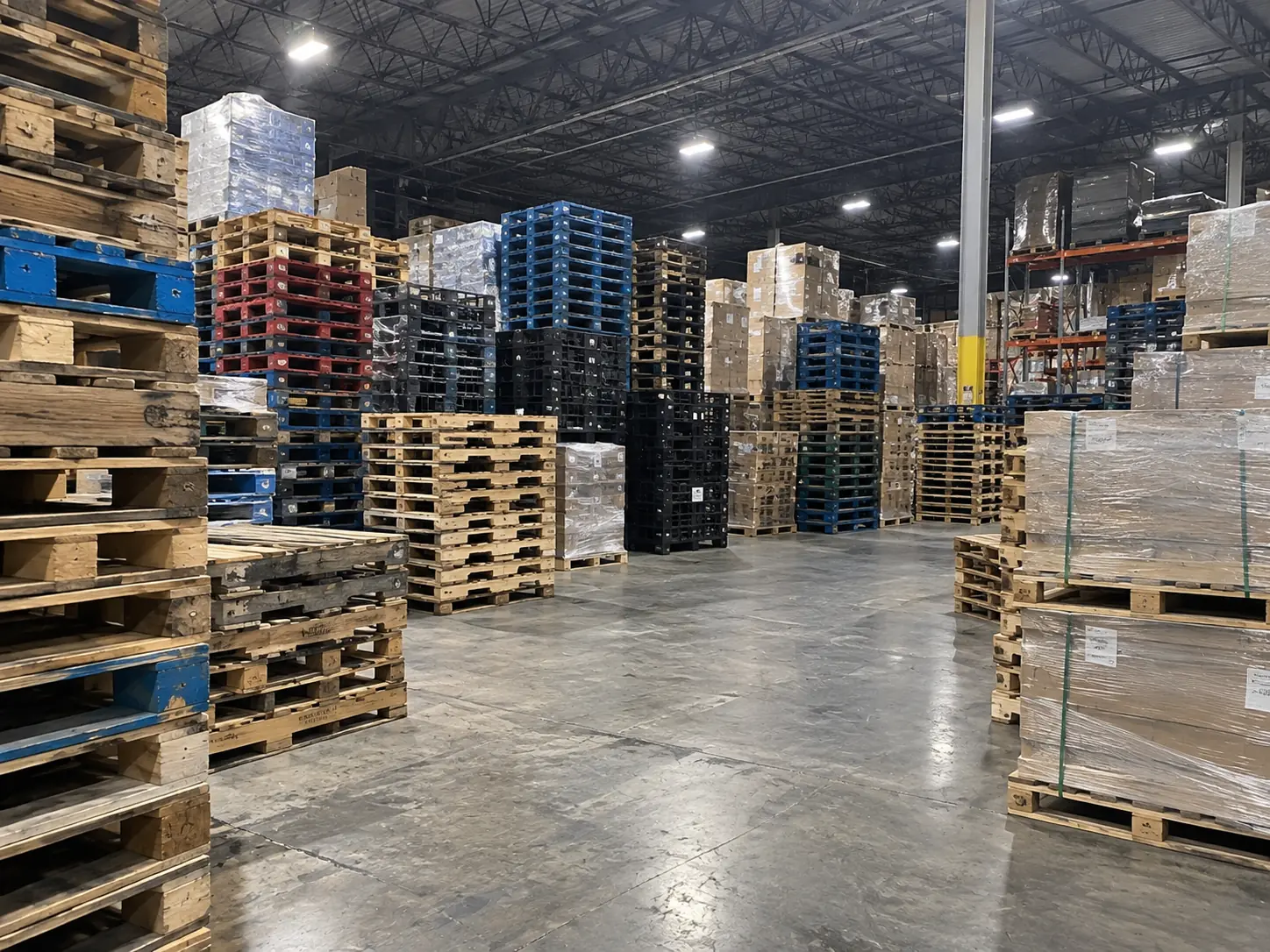
Grade vocabulary varies between yards, which creates most of the friction in this industry. Here is precisely what each of our grades means in terms a receiving inspector can check.
| Grade | Stringers | Deck boards | Appearance | Racking |
|---|---|---|---|---|
| A / #1 | No plugs, no companions, no visible cracks | 7 top, 5 bottom, all full width | Uniform colour, clean, no staining | Approved |
| B / #1 | Plugs permitted, no companions | 6–7 top, 4–5 bottom | Mixed colour, light wear | Approved |
| B / #2 | Plugs and companion stringers permitted | 5–7 top, 3–5 bottom | Visible repair, mixed widths | Case by case |
| #2 Economy | Multiple repairs permitted | 5+ top | Heavy wear, mixed species | Not recommended |
Whatever a grade is called, the question worth asking your supplier is: what will you reject? A yard that cannot answer that question in specific terms is not grading, it is sorting.
New pallets are frequently built from green lumber at 25–30% moisture. They shrink, boards loosen and nails back out in the first month. A recycled pallet has completed that movement.
A pallet that has already survived several trips has demonstrated that its lumber has no hidden defect. New wood has not been tested by anything.
No felling, no kiln, no mill transport. The dominant carbon cost of a recycled pallet is the truck that brings it to you.
Standing inventory ships in 24–72 hours. New builds are a 10–15 business day lead time in normal conditions.
Typically 40–60% below the equivalent new build, with the gap widest on standard footprints where core supply is deepest.
Fork entry, conveyor compatibility and racking behaviour are identical when grade is specified correctly. The forklift cannot tell.
| Attribute | Typical value |
|---|---|
| Footprint | 48 in × 40 in (1219 mm × 1016 mm) |
| Height | 5.5 in – 6.5 in |
| Weight | 33 – 48 lb depending on species and grade |
| Species | Mixed hardwood (oak, maple, poplar); softwood present in some lots |
| Deck configuration | 7 top / 5 bottom boards, flush or overhang |
| Stringers | 3 × nominal 1.5 in × 3.5 in, double-notched for four-way entry |
| Static capacity | 4,000 – 6,000 lb |
| Dynamic capacity | 2,000 – 2,800 lb |
| Racked capacity | 1,500 – 2,500 lb (A/B #1 grade only) |
| Moisture content | Below 19% for indoor and export stock |
| Units per 53-ft trailer | ~550 – 600 stacked and banded |
Print this and put it on the dock. Six checks, in this order, ten seconds a unit. It is the same sequence our graders work to, and the order matters more than the criteria because the decision terminates as early as possible.
Any crack over 3 in, any through-split, any metal plate — reject. This ends roughly one decision in six immediately, which is why it is first.
Any nail head standing proud is a shiner. Reject regardless of how good the rest of the pallet is. It scratches product, catches conveyors and cuts hands.
Seven and five for a full GMA. A missing interior board is minor; a missing lead board is not, because lead boards take the fork impact.
Plugs are acceptable at B. Companion stringers drop it to #2 and should stay out of racking. Plates are a reject.
Mould bloom, chemical staining, residue, odour. This is the check that protects everything downstream, and the one to be conservative on.
Colour uniformity, weathering, mixed species. Last, because it is the only criterion that does not affect whether the pallet works.
Checking appearance first is what untrained inspectors naturally do, because it is the most visible property. It means every unit gets a full inspection even when it was already disqualified at step one.
Published because buyers plan against an imagined pool rather than the real one. This is the composition of everything that crossed our weighbridge in the twelve months to August 2026, and it explains a lot about lead times on non-standard footprints.
| Footprint | Share of intake | What it means for availability |
|---|---|---|
| 48 × 40 GMA | 71.3% | Always available in every grade. The only footprint we never run short of. |
| 48 × 48 square | 6.1% | Rotating stock. Rising year on year with battery and energy freight. |
| 42 × 42 drum | 3.8% | Recovered supply thin — most of what we sell is remanufactured. |
| 48 × 45 automotive | 3.4% | Concentrated in the Detroit and Bowling Green lanes; remanufactured to order. |
| 36 × 36 beverage | 2.9% | Seasonal. Peaks June to September; ask early if you need it in spring. |
| 1200 × 800 Euro / EPAL | 2.6% | Arrives as import packaging and accumulates at importers, mainly Chicago. |
| 1200 × 1000 ISO 2 | 1.9% | Asia-sourced freight. Prime remanufacture feedstock for 42 × 42. |
| 40 × 48 reversed GMA | 1.4% | Stringers on the 40-in axis. Frequently mis-ordered as a 48 × 40 — check the drawing. |
| Everything else | 6.6% | Roughly forty further footprints across the year, none above 0.9%. |
The species mix underneath that is roughly 38% oak, 19% yellow poplar, 15% southern yellow pine, 11% maple, 7% ash and the remainder mixed. The pool leans hardwood because hardwood survives long enough to be recovered — it is survivorship, not preference, and it is why single-species recycled stock does not exist in volume no matter who promises it.
Unit price is the wrong comparison between recycled and new, because the two do different numbers of trips before they need attention. Cost per trip is the honest measure, and it changes the answer more often than people expect.
| Option | Trips before first repair | Repairable? | Residual core value | Where it wins |
|---|---|---|---|---|
| Recycled hardwood A/#1 | 4 – 7 | Yes, 4–7 cycles | Real | Racking, closed loops, grocery compliance |
| Recycled hardwood B/#2 | 3 – 5 | Yes, fewer cycles left | Real | Floor storage, internal movement, one-way |
| New hardwood build | 4 – 7 | Yes, full life ahead | Real | Automation, documented provenance, tight tolerance |
| New softwood build | 2 – 4 | Moderate — splits rather than cracks | Low | Weight-billed freight, one-way export |
| Plastic, closed loop | 30 – 100+ | No — regrind only | Low | Washdown, cold chain, high-return-rate loops |
| Plastic, open loop | 1 | No | None to you | Almost never. An expensive way to give away an asset. |