Custom Size Pallets
In short
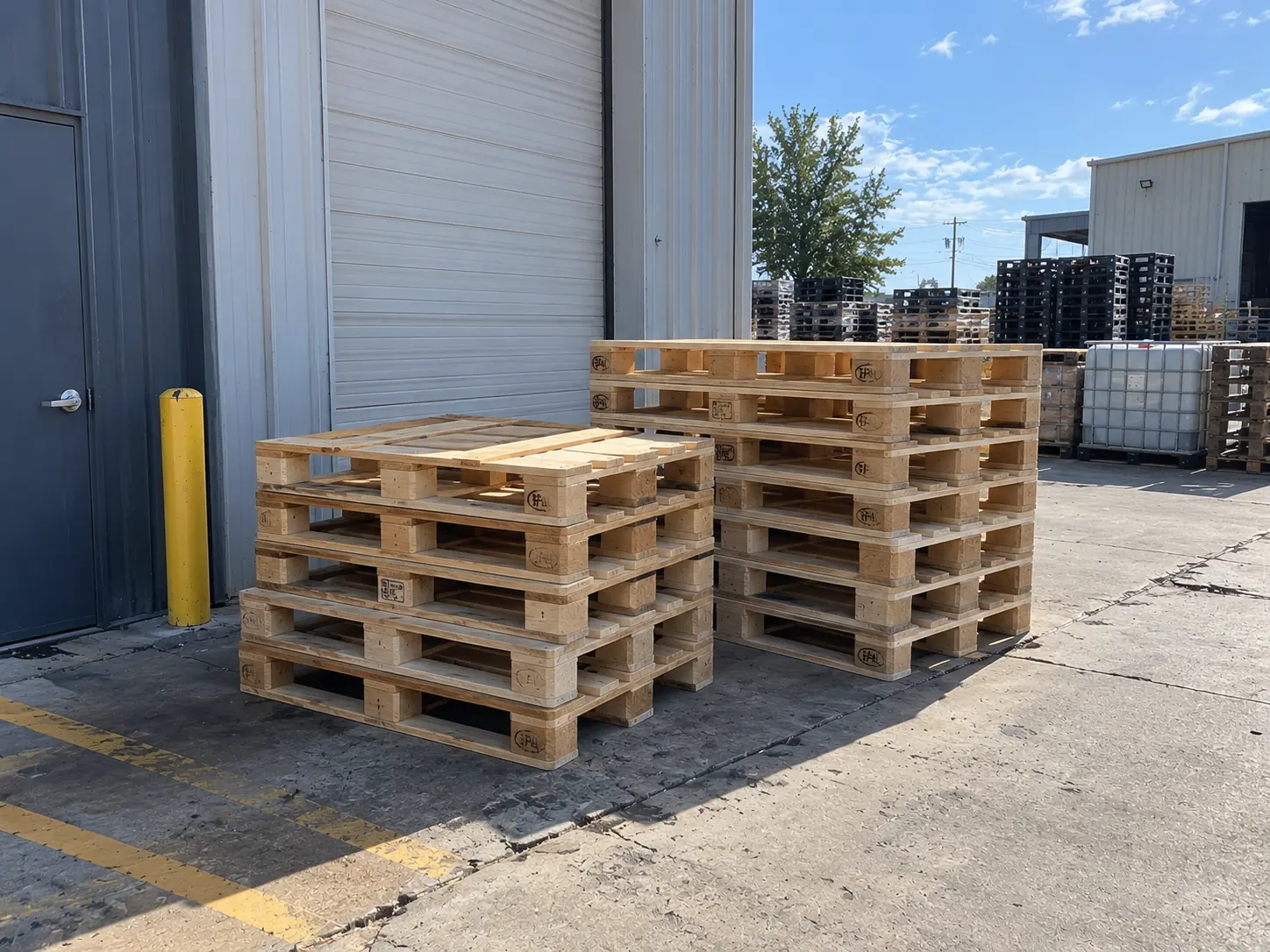
Odd-size pallets have a reputation for being expensive, and from a new-build supplier they are. We approach them differently: a destroyed 48x40 contains more than enough clean length to build a sound 42x42 or 36x36, so most of our odd sizes are remanufactured rather than milled. That keeps a non-standard footprint close to standard pricing.
Quote: Custom Size Pallets
Send the details and a named person at the Evendale yard replies within one business day with pricing, freight and a piece count — in writing.
Footprints we see most often
| Size (in) | Industry | Why it exists |
|---|---|---|
| 48 × 48 | Chemical, paint, cable | Four 55-gallon drums sit square with no overhang |
| 42 × 42 | Telecom, paint, chemical | Fits three drums plus handling clearance; common legacy standard |
| 36 × 36 | Beverage, brewing | Keg and case modules; fits short bay racking |
| 48 × 45 | Automotive | Tier-one supplier standard across much of the Midwest |
| 40 × 48 | Military, some industrial | Stringers running the 40-inch axis for specific handling |
| 48 × 42 | Retail, general | Deeper display footprint for large-format retail |
| 44 × 44 | Drum, industrial | Legacy drum standard, still widely specified |
| 32 × 30 | Display, retail | Quarter-pallet retail floor display |
| 1200 × 1000 mm | International, industrial | ISO 2; common in Asia-sourced freight |
| 1200 × 800 mm | European | Euro / EPAL standard |
Availability of any given odd size rotates with what arrives in our cores. Ask for current stock rather than assuming — and if it is not on the ground, we can usually remanufacture into it inside two weeks.
What "remanufactured" actually means
- Teardown
A destroyed pallet is stripped on a dismantler. Stringers and boards are separated and de-nailed.
- Trim and sort
Boards are cut back to sound wood and sorted by length and thickness. A 48-inch stringer with a failure at one end yields a clean 42-inch member.
- Jig build
Components are assembled on a fixed jig for the target footprint, with a documented fastener schedule identical to a new build.
- Grade and band
The finished unit is graded against the same criteria as any other pallet and banded for shipment.
A remanufactured pallet is, structurally, a new pallet made from old wood. It carries a calculated load rating, it holds dimension on a jig, and it costs a fraction of a milled build because the lumber is already in the building. For most odd-size applications it is simply the better answer.
Specifying a custom size
- Length along the stringer axis first, then width — state the convention you are using
- Overall height, or the deck and stringer thicknesses you need
- Load weight, distribution and stack height
- Fork entry required: two-way, four-way notched, or true four-way block
- Racking, conveyor or automation constraints
- Export and treatment requirements
- Annual volume and reorder frequency — this determines whether a fixed jig is worth building
Remanufacture yield: which sizes come out of which
Odd sizes are expensive from a new-build supplier because a short run of a low-volume product genuinely costs more. We approach them differently: a destroyed 48-inch stringer trims to a clean 42-inch member, so most of our odd sizes are rebuilt rather than milled. This table is the yield logic, and it explains why some non-standard sizes price near standard and others do not.
| Target footprint | Yielded from | Yield quality | Typical premium over recycled 48×40 |
|---|---|---|---|
| 42 × 42 | 48-in stringers trimmed past damage | Excellent | 10 – 18% |
| 36 × 36 | 48-in stringers trimmed | Excellent | 10 – 20% |
| 40 × 40 | 48-in stringers trimmed | Very good | 12 – 20% |
| 48 × 45 | Full 48-in stringers, narrower deck | Very good | 12 – 22% |
| 44 × 44 | 48-in stringers trimmed | Good | 15 – 25% |
| 32 × 30 | Short offcuts otherwise bound for fibre | Good | 10 – 20% |
| 24 × 40 half pallet | Trimmed boards and short stringers | Good | 15 – 25% |
| 48 × 48 | Needs full-length stringers — no trim advantage | Limited | 25 – 40%, or buy new |
| Over 48 in on either axis | No yield from standard stock | None | New build |
Footprints we hold or have built
Availability of any given odd size rotates with what arrives in our cores, so ask for current stock rather than assuming. Anything not on the ground can usually be remanufactured inside two weeks.
| Size (in) | Metric (mm) | Sector it comes from |
|---|---|---|
| 48 × 48 | 1219 × 1219 | Chemical, drums, bulk bags, cable reels, battery |
| 42 × 42 | 1067 × 1067 | Chemical, paint, telecom |
| 48 × 45 | 1219 × 1143 | Automotive tier-one |
| 36 × 36 | 914 × 914 | Brewing, beverage, dairy |
| 40 × 48 | 1016 × 1219 | Military, specific handling |
| 48 × 42 | 1219 × 1067 | Large-format retail display |
| 40 × 40 | 1016 × 1016 | Dairy, beverage |
| 44 × 44 | 1118 × 1118 | Legacy drum, petroleum |
| 48 × 36 | 1219 × 914 | Beverage, packaged goods |
| 35 × 45.5 | 889 × 1156 | Defence logistics |
| 32 × 30 | 813 × 762 | Quarter-pallet retail display |
| 24 × 40 | 610 × 1016 | Half pallet, retail, direct store delivery |
| 24 × 20 | 610 × 508 | Quarter pallet, small-format retail |
| 1200 × 800 | 1200 × 800 | European distribution |
| 1200 × 1000 | 1200 × 1000 | Industrial, Asia-sourced freight |
| 1140 × 1140 | 1140 × 1140 | Australia, Asia-Pacific |
| 1100 × 1100 | 1100 × 1100 | Asian distribution |
| 1067 × 1067 | 1067 × 1067 | North American export |
| 800 × 600 | 800 × 600 | European retail display |
| 600 × 400 | 600 × 400 | European quarter, direct store delivery |
What a jig costs you
Nothing, on an active account, and we keep it indefinitely. This is worth stating plainly because tooling charges are common in this industry and they create a switching cost that has nothing to do with the quality of the work.
- The jig is built during the prototype stage and fixed on your approval at gate five.
- Your specification gets a number that appears on every future quote, bill of lading and grade sheet.
- Reorders skip discovery and go straight to scheduling — 10 to 15 business days in normal conditions.
- The jig stays on file for as long as the account is active, and for two years after the last order in case you come back.
- If you leave, we will send you the drawing and the fastener schedule. We would rather earn the next order than hold your specification hostage.
The one genuine cost is the prototype run, billed at cost — one to five units built on a temporary jig so you can load-test with your actual product before committing to a production quantity. Skipping that step is the most expensive saving available in custom work.