Pallet Grades Explained
In short
Recycled pallet grades describe two things at once: how much repair a pallet has had, and how good it looks. A grade means no visible repair and uniform appearance. B grade permits plugs and companion stringers. The number — #1 or #2 — describes the deck board count and structure. Nobody enforces these definitions industry-wide, which is why you should always ask a supplier what they reject rather than what they call things.
Quote: Pallet Grades Explained
Send the details and a named person at the Evendale yard replies within one business day with pricing, freight and a piece count — in writing.
The vocabulary problem
There is no legally binding grading standard for recycled wood pallets in North America. There are conventions, and they are widely shared, and they are also applied loosely enough that one yard's A grade is another yard's B. This causes more disputes than price does. The way through it is not to argue about names; it is to agree on rejection criteria in writing before the first trailer moves.
The grades in detail
A Grade / Premium / #1
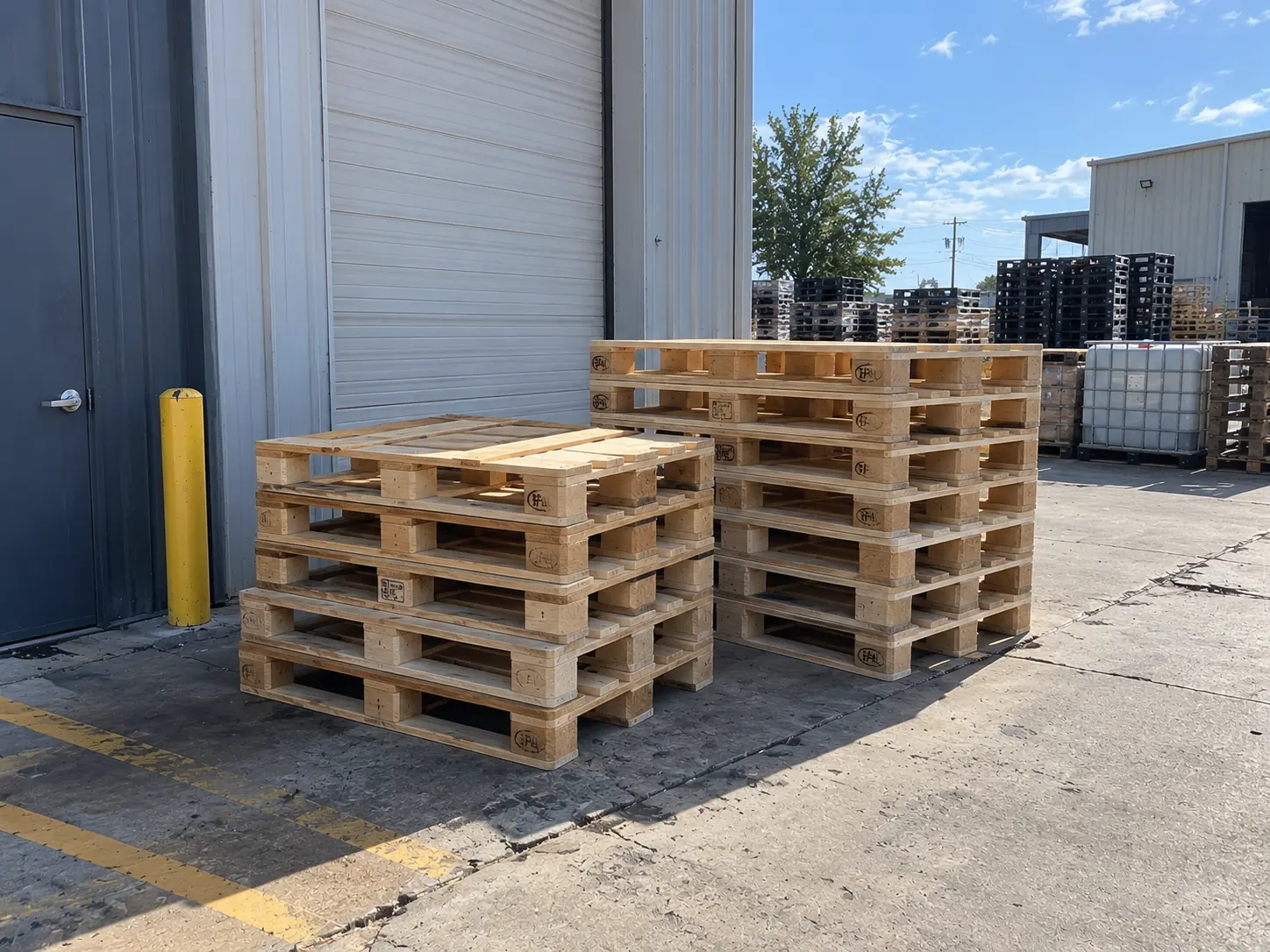
The best recycled pallet available. No plugged stringers, no companion stringers, no cracked members. All seven top deck boards present and full width. Consistent colour, which in practice means the wood is of similar age and species. No staining, no residue, no odour. Structurally equivalent to a new pallet for almost every application, and approved for racking.
B Grade / Standard
Structurally sound with visible evidence of repair or wear. Plugged stringers are permitted. Deck boards may be mixed in width and colour. May have six top boards rather than seven. Suitable for general distribution, inbound raw material and most racking applications where the repair is a plug rather than a companion.
#2 Grade / Economy
Repaired more than once, often with companion stringers. Mixed species and board widths. Visibly used. Still rated for around 2,000 lb static and entirely appropriate for floor-stacked storage, internal movement and one-way shipments where the pallet is not coming back. Not recommended for racking.
Remanufactured
Built on a jig from recovered components. Grade depends on the build spec, not on the history of the wood. A well-built remanufactured pallet can be A grade. This is the category most buyers misunderstand and most often under-value.
Grade selection matrix
| Application | Recommended grade | Why |
|---|---|---|
| Grocery DC with retailer compliance audit | A / #1 | Appearance is inspected and non-conformance carries chargebacks |
| Selective pallet racking, long-term storage | A or B / #1 | Racked loading plus creep demands undamaged stringers |
| Automated conveyor and AS/RS | A / #1 or new | Dimensional consistency and no shiners |
| General outbound distribution | B / #1 | Sound structure, appearance not audited |
| Inbound raw material receiving | B / #2 | Pallet is discarded or recycled on arrival |
| Floor-stacked warehouse storage | B / #2 | No racked loading, no edge support required |
| One-way shipment to a customer | #2 Economy | Pallet is not returning; buy the minimum that survives the trip |
| Yard staging and scrap movement | #2 Economy | Lowest cost that holds together |
| Export with ISPM-15 | A or B, heat treated | Must be sound and bark-free to pass inspection |
Over-specifying grade is the most common and most expensive habit in pallet purchasing. Buying A grade for internal movement that never leaves the building can easily double a pallet budget for no operational benefit whatsoever.
Repair types and their grade impact
| Repair | What it is | Grade impact | Racking |
|---|---|---|---|
| Deck board replacement | Failed board pried and replaced | None to minor — stays A or B #1 | Approved |
| Stringer plug | Shaped hardwood block glued into a fork puncture | Drops to B | Case by case |
| Companion stringer | Full-length member nailed alongside a cracked one | Drops to #2 | Not recommended |
| Metal plate | Steel plate over a crack | Drops to #2; rejected by many DCs | No |
| Full remanufacture | Stripped and rebuilt on a jig | Graded on build spec | Per spec |
Metal plating deserves a specific warning. It is fast, it is cheap, and it introduces a hard steel edge into a wood structure. Plates catch on conveyor systems, damage product, and are explicitly rejected by most grocery and automotive receivers. We do not plate.
Our posted rejection criteria, verbatim
These are printed and mounted at both grading stations at Evendale. We wrote them down in 2011 after a third argument about what A grade meant, and customer complaints fell by roughly two thirds inside a quarter. The criteria themselves did not change — they simply stopped being remembered differently by different people on different days. Copy them, adapt them, or use them to test another supplier.
Universal — applies to every grade
- No cracked or split stringer longer than 3 in on any load-bearing member.
- No protruding or shiner nails on any deck surface, top or bottom.
- No metal plates. We do not apply them and we do not accept them inbound.
- No mould bloom, chemical staining, odour, pest damage or exit holes.
- Deck gaps within 3.5 in for fork and conveyor compatibility.
- Moisture content below 19% for stock going to indoor storage or export.
- No bark anywhere on stock destined for export.
Additional for A / #1
- No plugged stringers. No companion stringers.
- All seven top deck boards present and full width.
- Five bottom deck boards present, chamfered.
- Uniform colour across the deck — no heavily weathered board against a fresh one.
- No residue, no labels, no staining of any kind.
Additional for B grade
- Plugged stringers permitted. Companion stringers permitted, at #2.
- Six or seven top deck boards; mixed widths and colours accepted.
- Light wear and weathering accepted. Structure must be sound.
Additional for automotive and automation stock
- Zero shiners, inspected on both faces as a separate final pass.
- Height sorted to ±1/4 in with a gauge, not by eye.
- Footprint tolerance ±1/4 in — jig-built or remanufactured stock only.
- Build date, jig number and grade recorded per lot and supplied with the shipment.
Why units actually leave the reuse stream
Twelve months of grading decisions, by reason. This is the distribution behind the abstract discussion of grades, and it tells you where to look first when a unit is failing in your own building.
| Reason | Share of rejections | Note |
|---|---|---|
| Cracked or split stringer | 34.2% | Almost always at a notch — the point of highest bending stress. |
| Missing or broken deck board | 26.8% | Lead boards over interior boards by roughly two to one. |
| Shiner / protruding fastener | 11.4% | Refastened and returned to the line in most cases. |
| Moisture above 19% or mould bloom | 10.1% | Heavily seasonal: 18.9% of March rejections, 4.2% of July. |
| Contamination, staining or odour | 7.3% | Pulled by a person at the intake belt. |
| Companion or plate from a prior repair | 5.2% | Companions accepted at #2; plates rejected outright. |
| Dimensional variance | 3.1% | Diverted to non-automation stock rather than scrapped. |
| Pest damage or exit holes | 1.9% | Segregated. Never enters export or studio stock. |
Writing a grade into a purchase specification
Skip the letter. A letter is not enforceable and it means different things at different yards. Write the rejection criteria instead — these are the clauses that actually give a receiving clerk something to act on.
- State the construction: stringer or block; number of stringers; notched or not.
- State minimum deck board counts, top and bottom, and minimum board width.
- State the maximum permitted deck gap.
- State which repairs are acceptable: plugs yes or no, companions yes or no, plates never.
- State the maximum moisture content and where it is to be measured — stringer, mid-bundle.
- State appearance requirements only if they are genuinely audited downstream. If they are not, do not pay for them.
- State height tolerance if anything is automated, with the measurement method.
- State the treatment requirement, with the accredited facility number to appear on the mark.
- Require a grade sheet per lot, including the rejection percentage pulled from that lot.
- State the remedy: collect and replace within a stated period, not credit notes and argument.