The scale house
Every inbound trailer is weighed and counted before anything is unloaded. Weight in and weight out is what makes a diversion rate auditable rather than aspirational, and it is the first thing an auditor asks to see.
Nine stations under one roof at 10400 Evendale Dr, Cincinnati, OH 45241: a scale house, an intake segregation belt, two grading lines, a repair bench floor, a mechanised dismantling line, remanufacture jigs, an accredited ISPM-15 kiln, a grinder with double magnetic separation, and a studio. Visitors are welcome during business hours — Monday to Friday 7:00 AM to 5:00 PM and Saturday mornings — and no appointment is required, though telling us you are coming means somebody will be free to walk you round.
Tell us roughly when and what you would like to see. Buyers usually want the grading line; sustainability teams usually want the scale house and the magnets.
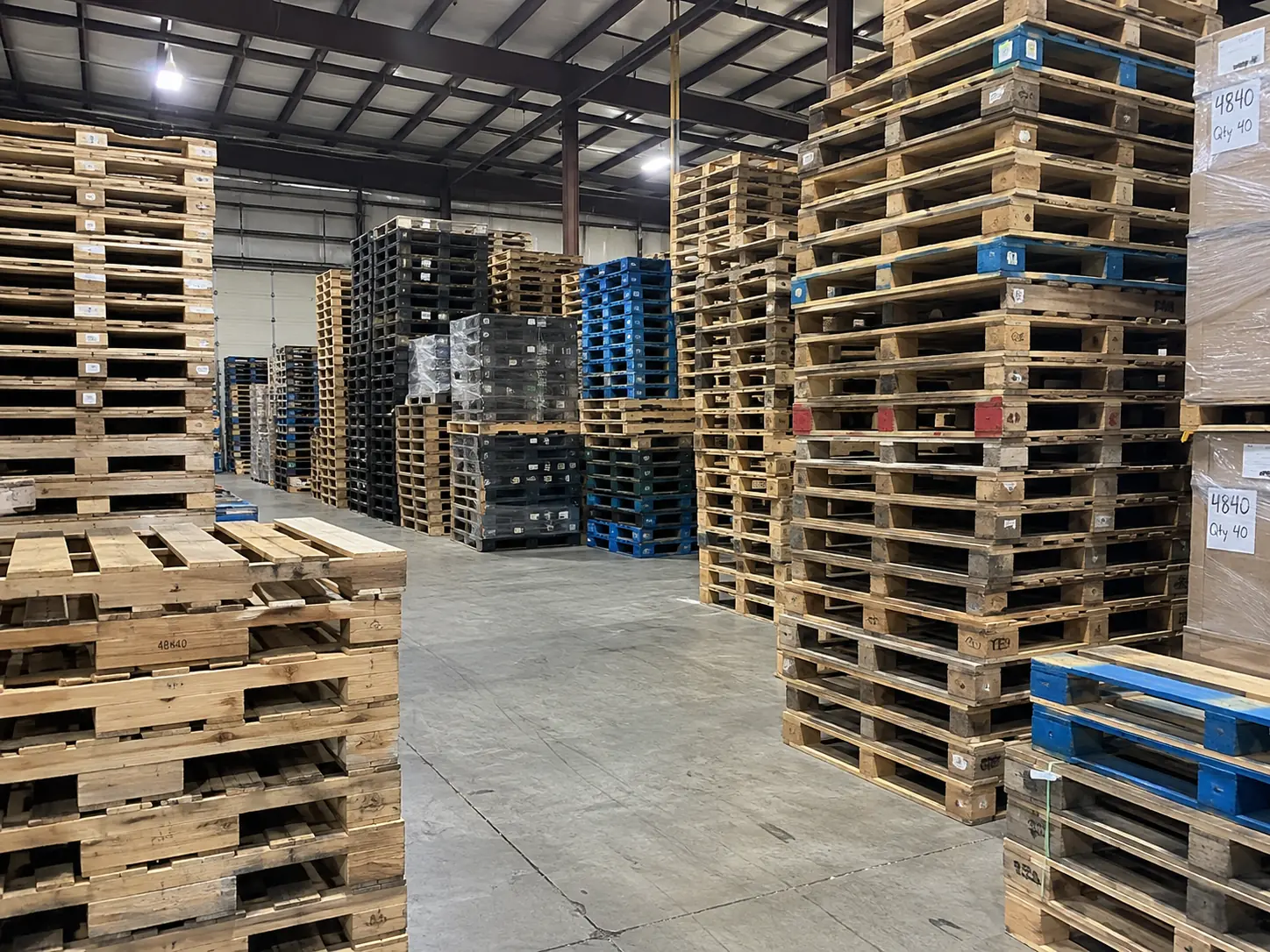
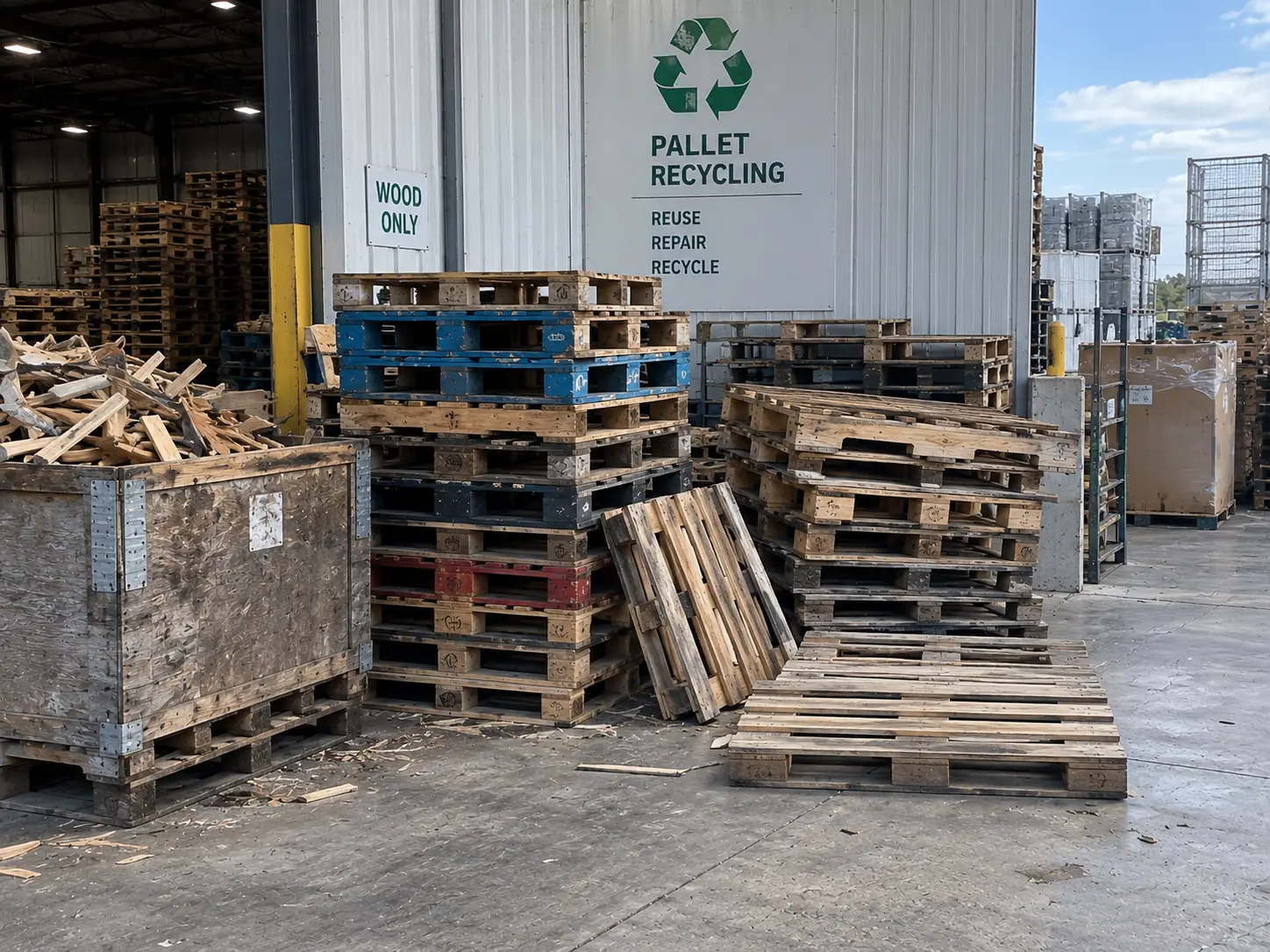
A pallet entering this building is tested against five outcomes in descending order of value before anybody reaches for a grinder. The layout below is that hierarchy, made physical.
Every inbound trailer is weighed and counted before anything is unloaded. Weight in and weight out is what makes a diversion rate auditable rather than aspirational, and it is the first thing an auditor asks to see.
A person at the belt pulls painted, chemically stained and methyl-bromide-stamped wood before it can reach any downstream process. This is the least automated step in the building and the one we are least willing to automate.
Sound cores are cleaned, inspected against posted rejection criteria, graded and banded in stacks of 12 to 25. Roughly 55% of intake never needs a tool. The criteria are on the wall so a new grader on a Tuesday applies them exactly as the lead does on a month-end Friday.
Deck board replacement, stringer plugs, companion stringers and jig rebuilds. Helically threaded hardened shanks, minimum 2.25 inch on stringer work — smooth shanks back out under vibration and are the usual reason a repaired pallet fails again within a month.
Mechanised teardown with a drum magnet on the discharge. Boards are stripped, de-nailed, trimmed back to sound wood and stacked by length and thickness. This is the pile that feeds every repair bench in the building.
Fixed jigs for 42×42, 36×36, 48×48, 48×45 and about a dozen customer-specific footprints. A wrecked 48-inch stringer trims to a clean 42-inch member, which is why our odd sizes price near standard rather than near new.
Accredited ISPM-15 heat treatment. Probes are set in the thickest members of the load, not in the chamber air, and the cycle holds until every probe reads 56°C for thirty continuous minutes. Cycles are logged automatically and filed against your order number.
The last three percent. A cross-belt magnet on the grinder outfeed catches nails freed by the grinding action itself — the stage most yards skip and the reason people find nails in cheap mulch. A trommel then removes oversize and fines before colouring.
A small shop at the back for wood too old and too good to grind. Boards are hand de-nailed, passed through a metal detector, kiln dried to 6–8% — furniture dry, not pallet dry — planed, and built into panels, fixtures and furniture.
This is a working yard with forklifts, trailers and a grinder in it. The rules below are short and we enforce them.
| Station | Throughput | Constraint | Measured on |
|---|---|---|---|
| Scale house | Every inbound and outbound trailer | Nothing — it is a weighbridge | Reconciliation between in and out |
| Intake segregation | ~118,000 pallets a month | Human attention. Deliberately not automated. | Contamination caught vs escaped |
| Grading line 1 & 2 | ~55% reused, ~4 sec a unit | Consistency, not speed | Rejection rate per lot |
| Repair benches | ~27% of intake, 2–10 min a unit | Harvest stock availability | Rework rate per bench, per shift |
| Dismantling line | ~9% of intake | Magnet performance on the discharge | Board yield per unit torn down |
| Remanufacture jigs | ~5% of intake | Trimmed component sorting upstream | Dimensional tolerance held |
| Kiln | Export orders only | Species and section set cycle length | Lowest-reading probe, 30 min at 56°C |
| Grinder, magnets, trommel | ~3% of intake | Second magnet placement, post-grind | Ferrous recovered per ton ground |
| Studio | Small by design | Kiln schedule — drying is the long pole | Moisture at 6–8% before milling |
Both could be. Neither should be, and it is worth explaining why rather than letting it look like we simply have not got round to it.
A person stands at the belt and pulls painted, chemically stained and MB-stamped wood before it can reach any downstream process. Vision systems can find some of this. They cannot smell a solvent, and they cannot make the judgement call on an unfamiliar coating. Everything that reaches our mulch, our bedding and our studio depends on this step, so it stays human.
Mechanical sorting can measure height, footprint and board count. It cannot weigh whether a particular plug on a particular stringer will hold for this customer's racking. Graders apply posted criteria, and the criteria exist precisely so that judgement is bounded rather than arbitrary.
What we have automated: the dismantling line, magnetic separation on two discharges, kiln cycle logging, weighbridge capture and the reporting built on top of it. The pattern is that measurement and material handling are automated, and the two decisions that determine what ends up in a customer's building are not.