Container loading: when a smaller pallet ships more product
In short
Ocean containers have interior widths that do not divide evenly by North American pallet footprints, so standard sizing frequently wastes a strip of floor down the length of the box. Changing footprint, rotating the loading pattern, or dropping the pallet entirely in favour of slip sheets can each recover a meaningful percentage of a container — and on a regular export lane that is the fastest payback in packaging.
Talk to us about this
If this piece describes a problem you actually have, describe it back to us in the message field. You will get a written answer from a person within one business day.
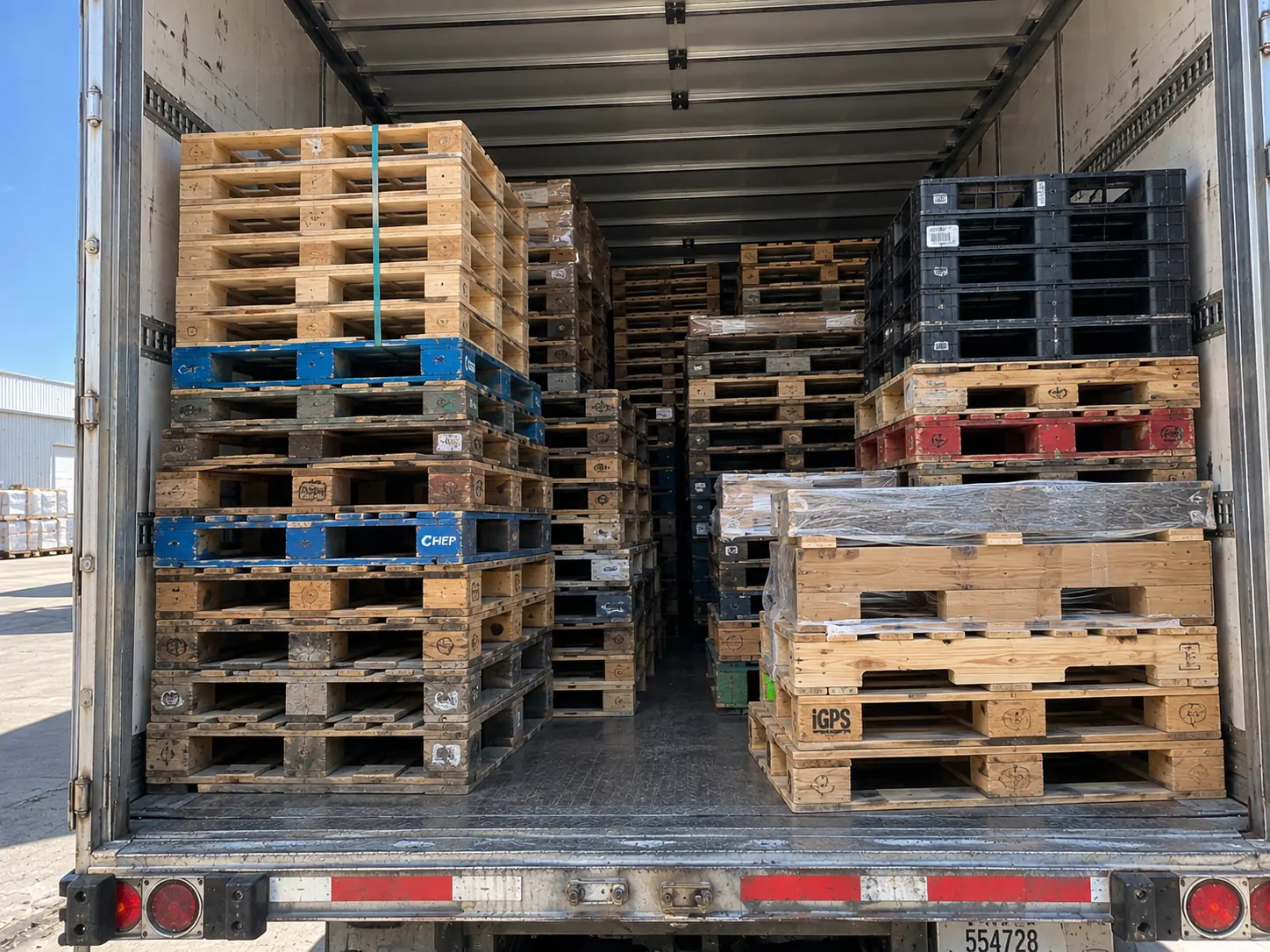
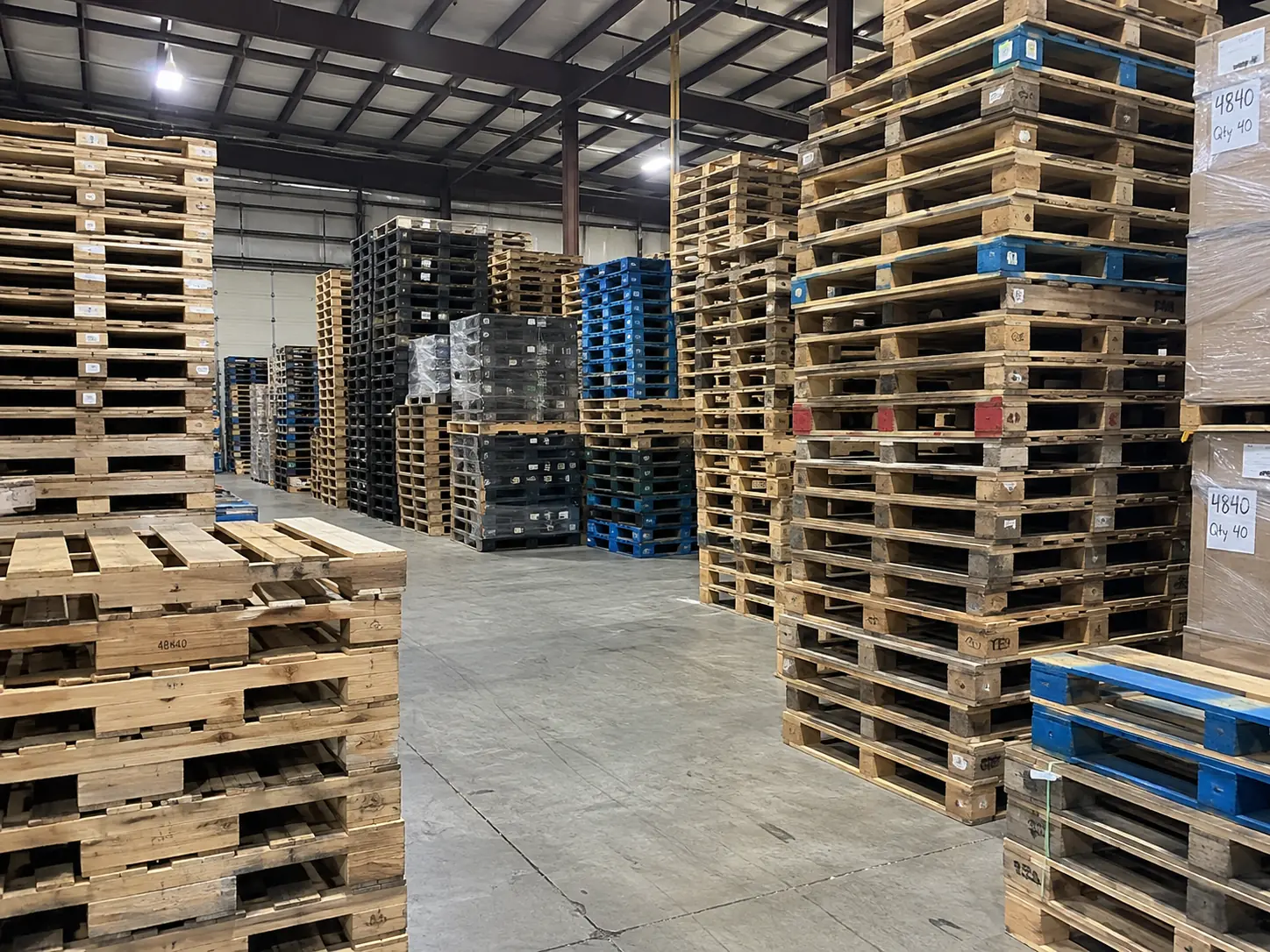
The arithmetic
| Container | Usable interior | Standard 48×40 positions | Notes |
|---|---|---|---|
| 20-ft standard | ~19 ft 4 in × 7 ft 8 in | 10–11 | Weight limits usually bite before cube |
| 40-ft standard | ~39 ft 5 in × 7 ft 8 in | 20–21 | The default for most export lanes |
| 40-ft high cube | ~39 ft 5 in × 7 ft 8 in, 8 ft 10 in tall | 20–21 floor, more height | Extra height is where slip sheets pay |
| 45-ft high cube | ~44 ft 5 in × 7 ft 8 in | 24–25 | Best cube per unit of freight on long lanes |
Seven feet eight inches is 92 inches. Two 48-inch pallets side by side occupy 96 — they will not fit across. Two 40-inch sides occupy 80, leaving a 12-inch strip of wasted floor running the entire length of the container. That strip is roughly 13 percent of the floor area, and it is there on every single container unless somebody has thought about it.
Four ways to recover the strip
- Rotate the pattern
Load pallets with the 48-inch dimension running the length of the container rather than across it. Costs nothing, takes a conversation with the loading crew, and frequently recovers a position or two.
- Change the footprint
A purpose-built footprint tuned to 92 inches of width — for example two 45-inch pallets across — can eliminate the wasted strip entirely. On a regular lane this pays back extremely quickly.
- Go pallet-free with slip sheets
A slip sheet is a thin plastic or kraft sheet with a gripping tab, handled with a push-pull forklift attachment. It recovers roughly 5 inches of height and 40 lb of dead weight per position, and it is ISPM-15 exempt because there is no solid wood.
- Floor-load selectively
For dense, robust, uniform product, floor-loading uses every cubic inch. The cost is labour at both ends, which is why it suits low-value, high-density goods and almost nothing else.
Weight-limited or volume-limited: they want opposite answers
Before optimising anything, establish which constraint you actually hit. A container of liquid in glass hits its weight limit long before it fills; a container of empty plastic components fills long before it weighs anything.
- Weight-limited: every pound of pallet is a pound of product not shipped. Move to softwood or slip sheets. Footprint optimisation is nearly irrelevant.
- Volume-limited: footprint and height optimisation is everything. Pallet weight barely matters; wasted floor strip matters enormously.
- Both limits close together: this is the good case. Small changes in either direction produce gains, and slip sheets help with both at once.
Slip sheets only work if the receiving end has a push-pull attachment. Confirm before converting a lane — a container of slip-sheeted freight arriving at a dock with no push-pull is a very long day for somebody, and it happens more often than it should.
Appendix: the data behind this
Every piece on this site closes with the slice of our operating record that bears on what it argues. The full record is published at /resources/operating-record.
Trailer and container fit by footprint
Read across a row and the trade-off becomes obvious: the footprint that wins in a 53-ft van is not always the one that wins in a 40-ft container.
| Footprint | 53-ft van | 48-ft van | 40-ft container | 20-ft container | 45-ft HC | Empty, 53-ft |
|---|---|---|---|---|---|---|
| 48 × 40 | 28 | 24 | 20 | 10 | 24 | ~560 |
| 48 × 48 | 24 | 22 | 18 | 9 | 22 | ~480 |
| 42 × 42 | 26 | 24 | 20 | 10 | 24 | ~600 |
| 36 × 36 | 39 | 33 | 30 | 14 | 34 | ~700 |
| 48 × 45 | 26 | 22 | 18 | 9 | 22 | ~520 |
| 1200 × 800 | 30 | 26 | 25 | 11 | 28 | ~520 |
| 1200 × 1000 | 24 | 22 | 20 | 10 | 24 | ~460 |