Designing a pallet for a robot instead of a forklift
Written by the The grading floor at Cincinnati, OH · 8 minute read · Specification
In short
Robotic handling removes the human compensation layer that has quietly propped up sloppy pallet specifications for decades. Autonomous mobile robots need consistent bottom-deck geometry and predictable height; robotic palletisers need a flat, gap-controlled top deck; vision systems need consistent contrast and edges. None of these are cosmetic requirements, and none of them correlate with pallet grade.
Talk to us about this
If this piece describes a problem you actually have, describe it back to us in the message field. You will get a written answer from a person within one business day.
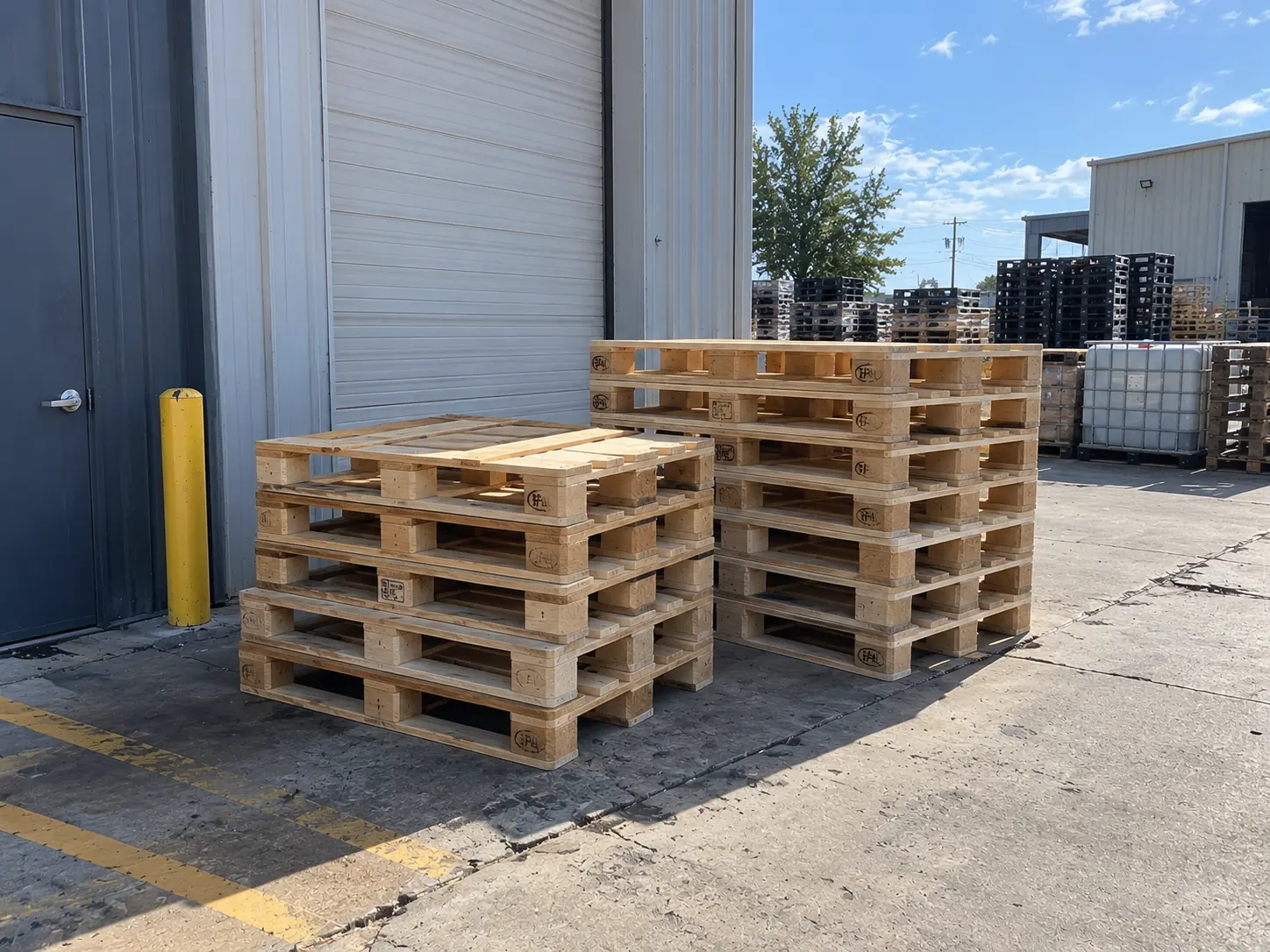
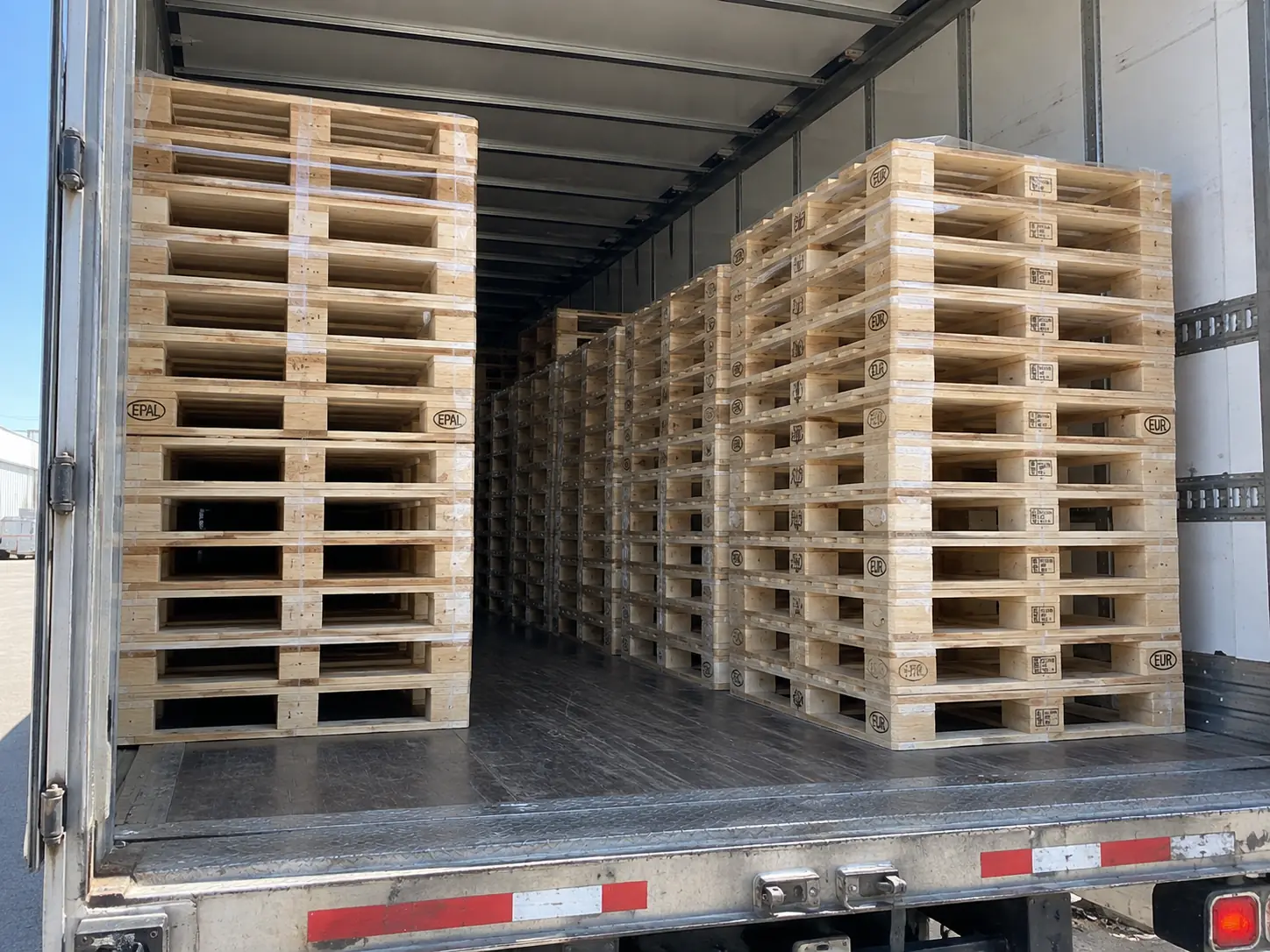
New block pallets outside the kiln door. Nothing ships for export until the treatment record is filed against the order.A trailer of EPAL block pallets loaded two-across. Every unit stamped, banded and counted before the doors close.
The human compensation layer
Every experienced forklift operator continuously corrects for imperfect pallets. They feel a tine catch and back out. They notice a deck board flexing and take it slower. They see a stringer that looks wrong and put the unit aside. None of this is written down, most of it is not conscious, and all of it disappears the moment the handling is automated.
This is why automation projects so often surface pallet problems that were always there. The pallets did not get worse. The system stopped hiding them.
What each kind of machine needs
01
Autonomous mobile robots (under-pallet)
Lift from beneath, so bottom-deck geometry is everything: consistent board placement, full chamfers, no missing boards, no protruding fasteners on the underside. Ground clearance must be predictable to a quarter inch.
02
AMRs with forks
Need consistent fork opening height and width. Notch geometry variance between repaired units is the usual failure, which is why block construction is frequently specified.
03
Robotic palletisers
Place cases onto the top deck. Small-footprint cases can drop into a 3.5-inch deck gap. Tight-laid or gap-controlled decks solve it; a slip sheet on top also works.
04
Depalletisers with vacuum
Need the top layer to sit flat. A cupped or twisted deck board defeats a vacuum gripper on the bottom layer.
05
Vision and barcode systems
Look for edges and contrast. A deck of heavily mixed light and dark boards can confuse edge detection. Uniform colour here is genuinely functional, not cosmetic.
06
Conveyor and shuttle
Index on height and engage the bottom deck. Height sorting matters more than any other single parameter.
Writing the specification
Start with the machine, not the pallet. Get the tolerance sheet from your integrator — it exists, and it is rarely shared with procurement.
Specify height as a sorted range, not a nominal. "6.0 in ±1/4" is a specification; "approximately 6 inches" is not.
Specify bottom-deck board count and placement explicitly, with chamfers required.
Specify maximum top-deck gap if a palletiser is placing small cases.
Require zero shiners on both faces, inspected — not assumed.
Decide on construction. Block gives consistency; jig-built remanufactured stringer is the middle ground; straight recycled stock is the value option and needs sorting.
Run fifty units through the actual system before signing an annual volume. Every integrator will tell you the same thing.
Appendix: the data behind this
Every piece on this site closes with the slice of our operating record that bears on what it argues. The full record is published at /resources/operating-record.
From the Evendale floor
The automation criteria, verbatim
Height sorted with a gauge, not by eye. Footprint held to a quarter inch. Zero shiners on both faces. Nothing in here is about how the pallet looks.
Universal — every grade
No cracked or split stringer longer than 3 in on any load-bearing member.
No protruding or shiner nails on any deck surface, top or bottom.
No metal plates. We do not apply them and we do not accept them inbound.
No mould bloom, chemical staining, odour, pest damage or exit holes.
Deck gaps within 3.5 in for fork and conveyor compatibility.
Moisture content below 19% for stock going to indoor storage or export.
No bark anywhere on stock destined for export.
Additional for A / #1
No plugged stringers. No companion stringers.
All seven top deck boards present and full width.
Five bottom deck boards present, chamfered.
Uniform colour across the deck — no heavily weathered board against a fresh one.
No residue, no labels, no staining of any kind.
Additional for automotive and automation stock
Zero shiners, inspected on both faces as a separate final pass.
Height sorted to ±1/4 in with a gauge, not by eye.
Footprint tolerance ±1/4 in — jig-built or remanufactured stock only.
Build date, jig number and grade recorded per lot and supplied with the shipment.