Drop trailer
Park a trailer once, load it over days, swap it when full. Turns one difficult manoeuvre a week into one difficult manoeuvre a month.
A 53-ft tractor-trailer needs roughly 110 to 130 feet of clear apron to back into a dock square. Sites with less than that force smaller equipment, more trips or manual repositioning, and every one of those adds cost per pallet. Measuring your apron before requesting a quote is the single most useful thing a receiving manager can do, and almost nobody does it.
If this piece describes a problem you actually have, describe it back to us in the message field. You will get a written answer from a person within one business day.
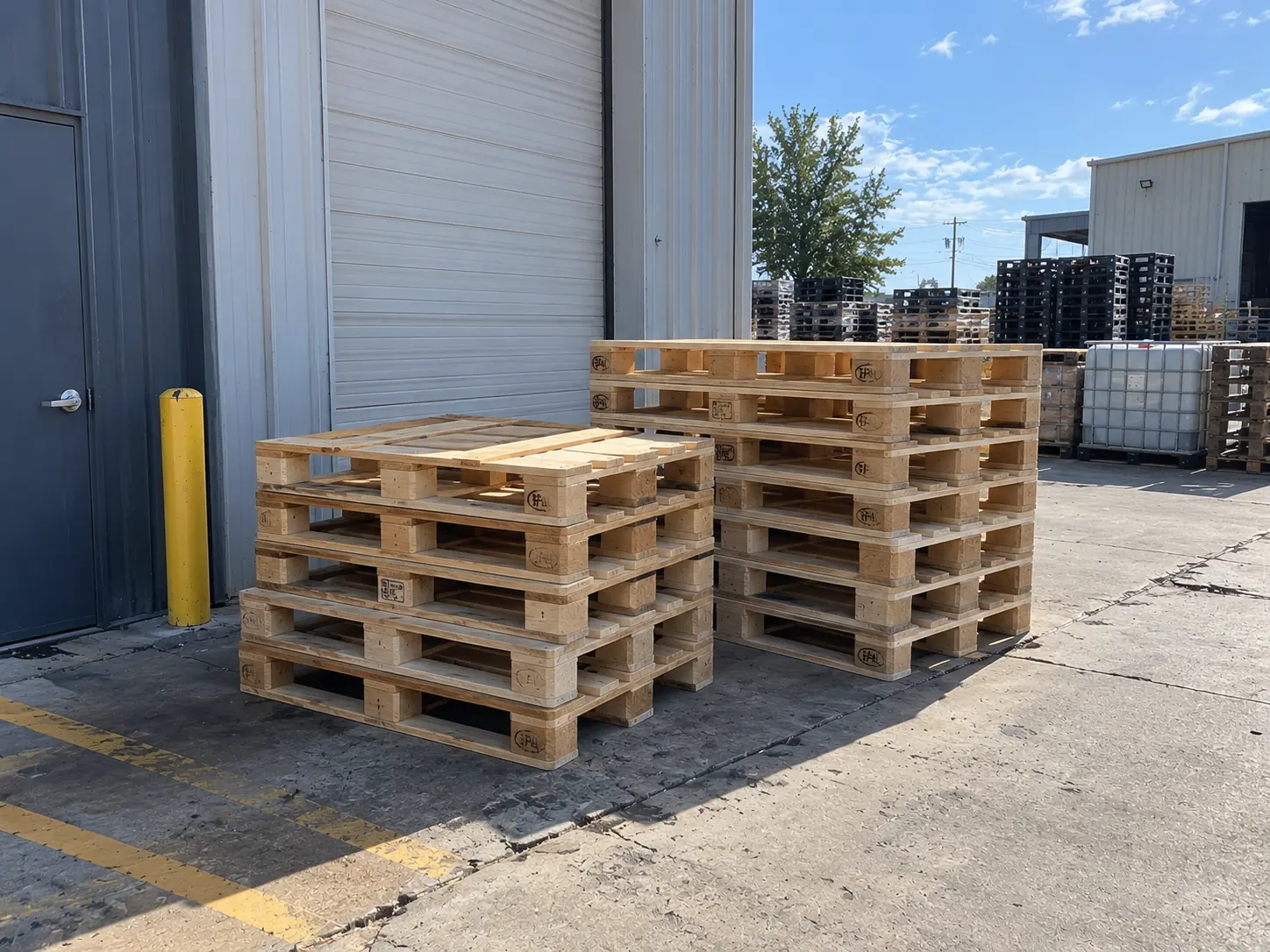
A tractor and 53-ft trailer is about 70 feet long. To place it square against a dock door, a driver needs room to swing the trailer through roughly 90 degrees while the tractor travels in the opposite direction. The working figure is 110 to 130 feet of clear depth in front of the door, and more if the approach is one-directional or the doors are closely spaced.
Below that, a driver can sometimes still make it with multiple pull-ups — which costs time, risks the trailer, and depends entirely on who is driving that day. Below about 90 feet it stops being a skill question and becomes a physics question.
| Apron depth | Practical equipment | Pallets per trip | Trips for 560 pallets |
|---|---|---|---|
| 130 ft or more | 53-ft dry van | ~560 | 1 |
| 110–130 ft | 53-ft dry van, careful approach | ~560 | 1 |
| 90–110 ft | 48-ft trailer or flatbed | ~480 | 2 |
| 60–90 ft | 26-ft box truck | ~140 | 4 |
| Under 60 ft / street only | 26-ft box truck with liftgate, kerbside | ~120 | 5 |
The interesting column is the last one. Freight cost does not scale with pallet count; it scales with trips. Four box-truck trips to move what one dry van would carry is close to four times the freight for the same wood. Nothing about the pallet has changed.
Park a trailer once, load it over days, swap it when full. Turns one difficult manoeuvre a week into one difficult manoeuvre a month.
If a neighbouring business takes deliveries too, sharing a route day splits the trip cost across two accounts. We arrange this more often than people expect.
An apron blocked by staff parking at 10am is often clear at 6am. The constraint is frequently temporal rather than physical.
For sites that genuinely cannot take a trailer, delivering to a nearby facility and shuttling in a box truck is sometimes cheaper than four direct box-truck runs.
Every piece on this site closes with the slice of our operating record that bears on what it argues. The full record is published at /resources/operating-record.
Read the apron column first, then the capacity column. The cost of a tight site is not the truck, it is the number of trips the truck has to make.
| Equipment | Empty stacked | Floor positions | Apron | Right for |
|---|---|---|---|---|
| 53-ft dry van | ~560 | 28 | 110–130 ft | Dock-height volume, dry cores, banded stock |
| 53-ft flatbed + straps | ~480 | 26 | 90–120 ft | Outdoor piles, wet stock, mixed loads, oversize |
| 48-ft dry van | ~500 | 24 | 95–115 ft | Older sites with shorter aprons |
| 26-ft box truck + liftgate | ~140 | 12 | 45–70 ft | Urban docks, alleys, retail, no forklift on site |
| Drop trailer (customer loaded) | ~560 | 28 | Parking only ft | Irregular accumulation, weather protection, no live load |
| Walking floor | — | — | 100–130 ft | Bulk mulch, bedding, hog fuel by the cubic yard |